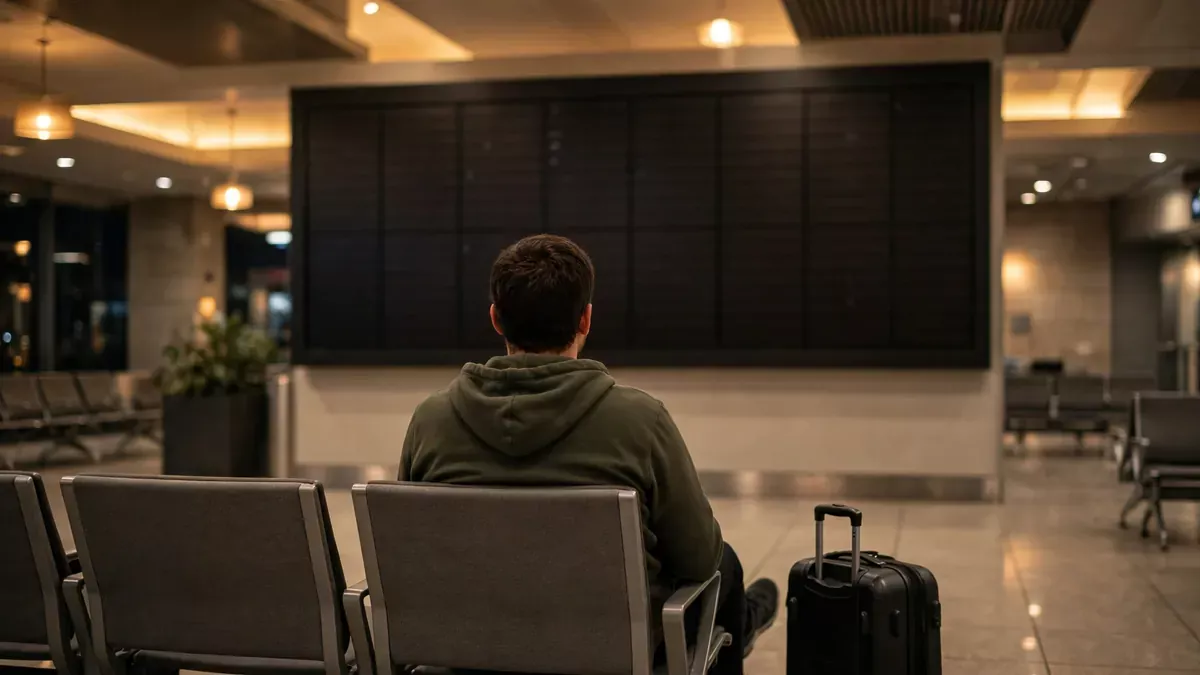
Your flight is cancelled, and the airline offers you a voucher. Your flight is delayed five hours, and the airline offers you nothing. Your bag does not arrive, and nobody can tell you where it is. In each case, the airline owes you something specific under US law, and knowing what it is changes the conversation at the gate.
The short answer is this: in the United States, a cancelled flight entitles you to a full refund if you choose not to travel, but there is no federal right to cash compensation for a delay. The rules are specific, and they are different from the rules in Europe.
Key Takeaways
- If an airline cancels your flight, or makes a significant change to it, and you choose not to travel, you are entitled to a full refund to your original form of payment.
- US law does not require airlines to pay cash compensation for delays. Meal vouchers and hotel rooms are offered under each airline’s customer service plan, not as a legal right.
- If you are involuntarily bumped from an overbooked flight, federal rules require compensation based on the length of your delay.
- Airlines cannot keep you on the tarmac for more than 3 hours on a domestic flight without giving you a chance to deplane.
- If your bag is lost or damaged, the airline must compensate you, up to a limit set by federal rules.
- If the airline does not resolve your complaint, you can file with the US Department of Transportation.
Table of Contents
Cancellation: the right to a refund
The clearest passenger right in US aviation law is the refund rule. If an airline cancels your flight, or makes a significant change to it, and you choose not to accept the alternative the airline offers, you are entitled to a full refund to your original form of payment. This is a rule from the US Department of Transportation, not a courtesy.
A significant change, as defined by the DOT, includes a departure or arrival time change of 3 hours or more for a domestic flight, or 6 hours or more for an international flight; a change in the departure or arrival airport; an increase in the number of connections; or a downgrade to a lower class of service. If any of these happens and you do not want the revised itinerary, the refund rule applies.
The refund must be automatic. Under a DOT rule that took effect in 2024, airlines must provide refunds automatically when a flight is cancelled or significantly changed and the passenger does not accept the alternative. You should not have to request it, fill out a form, or wait for a voucher. The refund goes to the original form of payment: the credit card you used, not a travel credit, unless you choose the credit.
The refund covers the full ticket price, including taxes and fees, for the unused portion of the trip. If you have already flown part of the trip and the airline cancels the return, the refund covers the return portion. If the cancellation makes the whole trip pointless, for example a cancelled outbound flight for a weekend trip, the refund can cover the entire itinerary.
The airline may offer you a voucher or a travel credit instead. You are not required to accept it. If you want a refund, say so, and cite the DOT rule. If the airline refuses, file a complaint with the DOT.
Delays: what the law does not require
Here is where US passenger rights are weaker than many travelers expect. There is no federal law requiring an airline to pay you compensation for a delayed flight, no matter how long the delay. If your flight is delayed by two hours, five hours, or twelve hours, the airline owes you no cash payment under US law.
What the airline does owe you depends on its customer service plan. Every airline operating in the US is required by the DOT to have a customer service plan, and to honor it. These plans typically promise meal vouchers for long delays, hotel accommodation for overnight delays, and rebooking on the next available flight. The details vary by airline and by the cause of the delay. Weather-related delays usually receive less than mechanical delays, because the airline does not control the weather.
The practical difference matters. A meal voucher is not a right. It is a promise the airline made in its own plan. If the airline does not honor its plan, you can complain to the DOT, and the DOT can take enforcement action. But the DOT cannot make the airline pay you a specific amount for the delay itself, because no rule sets one.
This is very different from the European Union, where Regulation EC 261/2004 requires airlines to pay cash compensation of 250 to 600 euros for delays of 3 hours or more, depending on the flight distance, unless the delay was caused by extraordinary circumstances. If you are flying from the EU, or on an EU-based airline, those rules apply to you, even if you are a US citizen. Many US travelers do not know this, and miss out on compensation they are owed for European flights.
Overbooking: involuntary denied boarding
Airlines overbook flights because some passengers do not show up. When more passengers arrive than there are seats, the airline first asks for volunteers to give up their seats, usually in exchange for a travel voucher and a later flight. If there are not enough volunteers, the airline denies boarding to some passengers involuntarily.
If you are involuntarily bumped, federal rules require the airline to compensate you. The amount depends on how long you are delayed in reaching your destination. For a domestic flight, if the delay is 1 to 2 hours, the compensation is 200 percent of your one-way fare, up to a cap set by the DOT. If the delay is more than 2 hours, the compensation is 400 percent of your one-way fare, up to a higher cap. The DOT adjusts these caps periodically for inflation.
The compensation must be paid in cash or by check, not only as a voucher, unless you agree to accept a voucher. The airline must also rebook you on the next available flight. If you are bumped and the airline offers you a voucher, you can ask for cash instead.
Volunteers are a different case. If you volunteer to give up your seat, you get whatever the airline offers, which is a negotiation. The DOT does not set a minimum for volunteers. If the airline is asking for volunteers, you can negotiate: ask for a higher voucher amount, a hotel room, a meal, or a confirmed seat on a specific later flight. The airline wants your seat, and you have leverage until you agree.
Tarmac delays: the 3-hour rule
If your plane is sitting on the tarmac, the DOT’s tarmac delay rule applies. For domestic flights, an airline cannot keep passengers on board for more than 3 hours without giving them the opportunity to deplane. For international flights departing from or arriving in the US, the limit is 4 hours. There are exceptions for safety, security, and air traffic control reasons, but the airline must return to the gate when it can do so safely.
After 2 hours on the tarmac, the airline must provide food, water, working lavatories, and medical attention if needed. The airline must also keep passengers informed about the status of the delay every 30 minutes.
The tarmac delay rule was created after a series of incidents in which passengers were stranded on planes for 8 to 11 hours. The fines for violating it are substantial, and the rule has been effective: long tarmac delays are now rare.
Lost and damaged bags
If your bag does not arrive, report it to the airline immediately, before leaving the airport. The airline will give you a file reference number. Most delayed bags are found and delivered within a day or two. The airline is responsible for returning the bag to you at no charge.
If your bag is declared lost, or if it is damaged, the airline must compensate you for the contents, up to a liability limit set by federal rules for domestic flights, and under the Montreal Convention for international flights. The domestic limit is adjusted periodically by the DOT. You will need to provide a list of the contents and their value, and receipts if you have them.
Keep receipts for any essentials you buy while your bag is delayed, such as toiletries and a change of clothes. The airline is required to reimburse reasonable expenses for delayed baggage, and your travel insurance may cover additional costs.
Do not check valuables. Airlines exclude certain items from liability, including cash, jewelry, electronics, and important documents. Carry these in your hand luggage.
How to claim what you are owed
The first step is always to ask the airline, at the airport if possible. Gate agents and customer service representatives can rebook you, issue vouchers, and start a refund. Be specific about what you are asking for, and polite. The person at the desk did not cause the delay, and they have more discretion than you might think.
If the airport staff cannot help, contact the airline’s customer service by phone or online. Keep a record of every interaction: the date, the time, the name of the person you spoke to, and what was promised. Keep all receipts, boarding passes, and booking confirmations.
If the airline does not resolve your complaint, file with the US Department of Transportation. The DOT’s Air Travel Consumer Protection office accepts complaints online, and it tracks them by airline. The DOT does not resolve individual complaints, but it uses complaint data to identify patterns and take enforcement action. An airline that receives a DOT complaint is more likely to resolve it than one that only hears from the passenger.
For European flights, file with the airline first, then with the national enforcement body in the EU country where the flight departed. The EU rules have a clearer compensation structure, and the enforcement bodies can order the airline to pay.
Frequently asked questions
The airline offered me a voucher instead of a refund. Do I have to accept it?
No. If your flight was cancelled or significantly changed and you choose not to travel, you are entitled to a refund to your original form of payment. You can accept a voucher if you prefer it, but the airline cannot force one on you.
My flight was delayed 6 hours. Am I owed anything?
Under US law, no cash compensation is required for a delay. The airline’s customer service plan may provide meal vouchers, a hotel room, or rebooking. If the flight was departing from the EU, EU rules may entitle you to cash compensation.
What counts as a significant change?
For a domestic flight, a schedule change of 3 hours or more, a change of airport, an added connection, or a downgrade. For an international flight, the time threshold is 6 hours. If the change meets the definition, the refund rule applies.
I was bumped. The airline offered a $200 voucher. Is that enough?
If you were involuntarily bumped, the airline owes you cash compensation based on your delay, not just a voucher. For a delay of more than 2 hours on a domestic flight, that is 400 percent of your one-way fare, up to the DOT cap. You can accept a voucher if you prefer, but you are entitled to ask for cash.
My bag has been missing for a week. What now?
After 5 to 14 days, depending on the airline, a delayed bag is declared lost. File a formal claim with the airline, listing the contents and their value. The airline must compensate you up to the liability limit. Keep all receipts for essentials you bought in the meantime.
Sources and further reading
- US Department of Transportation: transportation.gov: air travel consumer protection, refunds, and how to file a complaint.
- Federal Trade Commission: consumer.ftc.gov: travel rights, refunds, and how to resolve disputes with airlines.
- Federal Aviation Administration: faa.gov: air travel safety, tarmac delay rules, and passenger information.
For more on how flights are priced and what travel really costs, see how cars, insurance, and travel costs work, and for the insurance side of a disrupted trip, holiday travel insurance coverage. The money behind it all is explained in how money works in America, and our Auto & Travel section covers more of it.
This article is for general educational and informational purposes only and is not financial, legal, insurance, tax, or medical advice. Always consult a qualified professional regarding your specific situation.