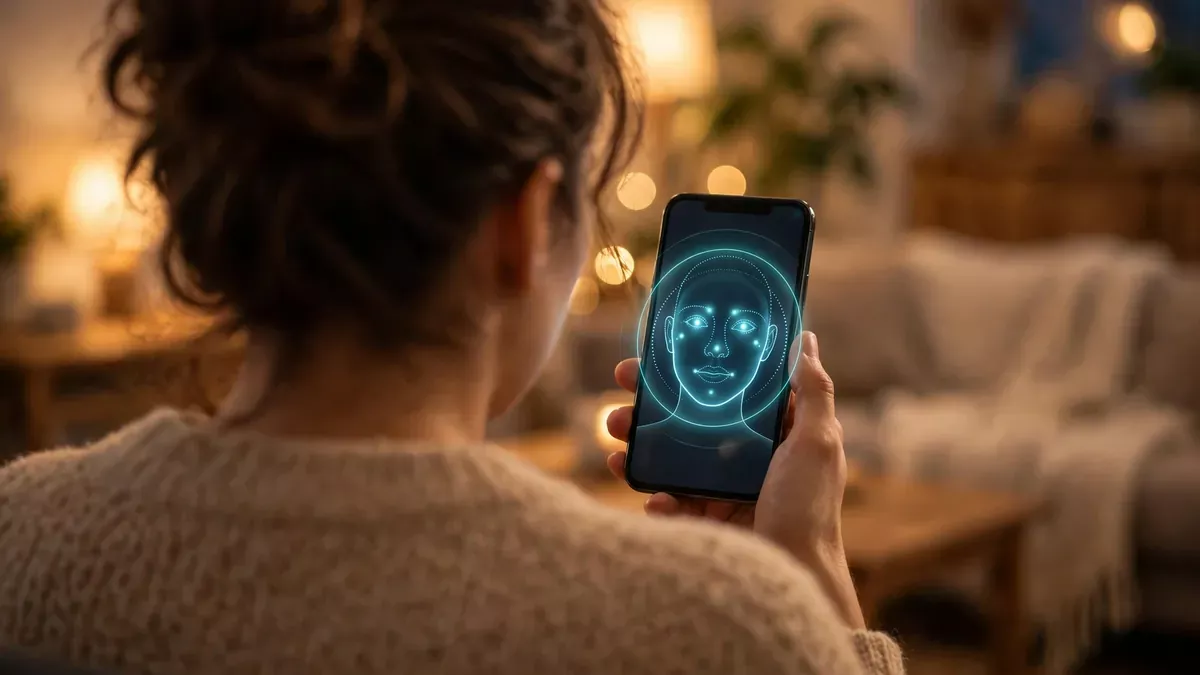
You glance at your phone, and it unlocks. You walk through an airport, and a camera matches your face to your passport photo. A social media app suggests tagging you in a friend’s photo before you have said a word. Your face has become a password, an ID card, and a tracking beacon, all at once.
Facial recognition feels like magic, but it is mathematics. A camera captures your face, software measures the geometry of your features, and an algorithm compares those measurements to a database. The process takes less than a second, and it is now woven into everyday life in ways most people do not notice.
The short answer is this: facial recognition works in three steps. First, the system detects a face in an image or video. Second, it analyzes the face, measuring the distances and proportions between features such as the eyes, nose, and jawline, and converts those measurements into a mathematical template called a faceprint. Third, it compares the faceprint against a database of known faceprints and returns a similarity score. If the score is high enough, the system declares a match.
Key Takeaways
- Facial recognition has three steps: detection (finding a face), analysis (measuring facial features and creating a mathematical template), and matching (comparing the template to a database).
- A faceprint is not a photo. It is a set of numbers representing facial geometry. It cannot normally be reverse-engineered into a recognizable image.
- 3D facial recognition, such as Apple’s Face ID, projects thousands of infrared dots to map the depth of your face. It is more accurate and harder to fool than 2D recognition from a regular photo.
- The National Institute of Standards and Technology (NIST) runs the Face Recognition Vendor Test, the gold standard benchmark. Top algorithms now have error rates under 1 percent for high-quality photos, but accuracy drops significantly for poor-quality images.
- NIST’s 2019 study found that most algorithms had higher false-positive rates for Black and Asian faces than for white faces, and for women than for men. The gap has narrowed in newer algorithms but has not disappeared.
- There is a critical difference between verification (1:1, “is this the enrolled user?”) and identification (1:many, “who is this person among millions?”). Phone unlocking is verification; law enforcement searches are identification, with much greater privacy implications.
Table of Contents
The three steps: detect, analyze, match
The first step, face detection, is the process of finding a face in an image or video. The system scans the image for patterns that look like a face: two eyes, a nose, a mouth, in roughly the expected arrangement. Modern detection uses machine learning models trained on millions of labeled images. Detection works even when the face is partially obscured, turned to the side, or in poor lighting, though accuracy decreases in these conditions.
Once a face is detected, the system moves to analysis. It identifies key landmarks on the face, typically 68 or more points, including the corners of the eyes, the tip of the nose, the edges of the lips, and the outline of the jaw. It measures the distances between these points, the angles, and the proportions. The measurements are converted into a mathematical representation, a vector of numbers, called a faceprint or facial template.
The faceprint is the core of the system. It is not a photograph, and it does not contain enough information to reconstruct a recognizable image of the face. It is a compact numerical summary of the face’s geometry. Two photos of the same person, taken at different times, in different lighting, and from slightly different angles, should produce similar faceprints. Two photos of different people should produce different faceprints.
The third step, matching, compares the faceprint against a database of known faceprints. The system calculates a similarity score, which measures how close the two templates are. If the score exceeds a threshold, the system declares a match. The threshold is adjustable: a higher threshold reduces false positives (wrong matches) but increases false negatives (missed matches). A lower threshold does the opposite. The choice of threshold depends on the application: a phone unlock can afford a false negative (you try again), but a law enforcement search cannot afford a false positive (an innocent person is flagged as a suspect).
2D vs 3D: why your phone is harder to fool
Not all facial recognition is the same. The simplest form, 2D recognition, works from a regular photograph. It analyzes the face as a flat image, measuring the visible features. 2D recognition is what most security cameras, social media tagging, and law enforcement systems use, because they work with ordinary photos and video.
2D recognition has a weakness: it can be fooled by a photograph. If the system only sees a flat image, a high-quality printed photo or a video played on a tablet can sometimes trick it into thinking the real person is present. This is called a presentation attack, or spoofing. Modern 2D systems include liveness detection, which checks for signs of life, such as blinking, head movement, or changes in skin texture, to distinguish a live person from a photo. Liveness detection helps, but it is not foolproof.
3D recognition, used by Apple’s Face ID and some Android phones, is fundamentally more secure. Instead of analyzing a flat photo, it maps the three-dimensional shape of the face. Face ID projects more than 30,000 invisible infrared dots onto the face and uses an infrared camera to measure how the dots are distorted by the face’s contours. This creates a detailed depth map, which is combined with a 2D infrared image to create the faceprint.
A 3D depth map cannot be fooled by a photograph, because a photograph has no depth. It is also much harder to fool with a mask, because the mask would need to replicate the exact three-dimensional geometry of the face. Researchers have demonstrated attacks using highly detailed 3D-printed masks, but these require access to a 3D scan of the target’s face and specialized equipment, making them impractical for most attackers.
The trade-off is that 3D recognition requires specialized hardware: an infrared projector, an infrared camera, and a depth sensor. This is why it is found in premium phones but not in most security cameras or webcams, which use 2D recognition.
How accurate is it
Facial recognition accuracy has improved dramatically over the past decade, but it is not perfect, and it varies significantly depending on the conditions.
The National Institute of Standards and Technology (NIST) runs the Face Recognition Vendor Test (FRVT), which is the most rigorous independent benchmark. The FRVT tests algorithms from dozens of vendors on millions of photos, measuring both false positives (incorrectly matching two different people) and false negatives (failing to match two photos of the same person).
The best algorithms in recent FRVT tests have false-positive rates below 0.1 percent for high-quality photos, such as passport photos taken under controlled conditions. This means that out of 1,000 searches, fewer than one would produce a false match. For lower-quality images, such as security camera footage, the error rates are much higher, sometimes 10 percent or more.
Accuracy also varies by demographic group. NIST’s 2019 demographic effects study, which tested 189 algorithms from 99 vendors, found that most algorithms had higher false-positive rates for Black and Asian faces than for white faces, and for women than for men. For some algorithms, the false-positive rate for Black women was up to 10 times higher than for white men. The study also found that the algorithms with the highest overall accuracy tended to have the smallest demographic gaps, suggesting that better algorithms are also fairer algorithms.
The demographic gap has narrowed in more recent tests, as vendors have trained their algorithms on more diverse datasets and improved their methods. But it has not disappeared, and it remains a serious concern, particularly for law enforcement use, where a false positive can lead to a wrongful arrest. There have been documented cases of people being wrongly arrested after a facial recognition match, and in several cases, the person misidentified was Black.
Where it is used
Facial recognition is used in more places than most people realize.
On your phone, it unlocks the device, authorizes payments, and verifies your identity for banking apps. Apple’s Face ID and Android’s face unlock are the most common examples. The faceprint is stored on the device, in a secure hardware component, and is not sent to the cloud. This is a privacy-protecting design: the company never sees your faceprint.
At airports, US Customs and Border Protection (CBP) uses facial comparison for international travelers. When you arrive in the US from abroad, a camera at the passport control kiosk captures your photo and compares it to the photo on file from your passport or visa. The system is designed to verify that you are the person on the travel document. CBP states that photos of US citizens are deleted within 12 hours, though privacy advocates have raised concerns about the retention of photos of non-citizens.
In law enforcement, facial recognition is used to identify suspects from security camera footage, to find missing persons, and to verify identities. Police departments in many US cities use facial recognition systems that search against databases of mugshots, driver’s license photos, and other images. The use of driver’s license photos, which were collected for a different purpose, has been particularly controversial.
In retail, some stores use facial recognition to identify known shoplifters, to personalize advertising, or to analyze customer demographics. In social media, Facebook (now Meta) previously used facial recognition to suggest photo tags, though it discontinued the feature in 2021 amid privacy concerns. Other platforms continue to use it.
The privacy questions
Facial recognition raises privacy questions that other technologies do not, because your face is both public and uniquely identifying. You cannot change your face the way you can change a password, and you cannot leave it at home the way you can leave your phone.
The first concern is consent. When a camera in a store, an airport, or a public square captures your face, you have not consented to having your biometric data collected. Unlike a password, which you choose to share, your face is visible to anyone who looks at you. The question is whether the mere fact that your face is visible in public means that anyone can collect, store, and analyze it.
The second concern is function creep. A system installed for one purpose, such as unlocking your phone, can be repurposed for another, such as tracking your movements. A database created for driver’s licenses can be searched by law enforcement. A photo you post on social media can be scraped and added to a facial recognition database without your knowledge. The company Clearview AI, which built a database of billions of photos scraped from the internet, is a prominent example of this concern.
The third concern is misidentification. As discussed above, facial recognition is not perfectly accurate, and its errors are not distributed evenly. A false positive in a law enforcement context can lead to a wrongful arrest, detention, or interrogation. The consequences fall disproportionately on people who are already overrepresented in mugshot databases and underrepresented in training data.
The legal landscape is evolving. Illinois’ Biometric Information Privacy Act (BIPA), enacted in 2008, requires companies to obtain written consent before collecting biometric data, including faceprints, and gives individuals the right to sue for violations. Several US cities, including San Francisco, Boston, and Minneapolis, have banned government use of facial recognition. The European Union’s AI Act, which took effect in 2024, restricts the use of real-time biometric identification in public spaces. At the federal level in the US, there is currently no comprehensive law governing facial recognition.
Frequently asked questions
Can facial recognition identify me from a photo on social media? Potentially, yes. If a facial recognition system has access to a photo of you, it can create a faceprint and search for matches in other photos. This is how Clearview AI built its database: by scraping photos from social media and other public websites. You can reduce the risk by limiting who can see your photos and by not tagging yourself in public photos, but you cannot eliminate it entirely if your photos are public.
Is Face ID safe? Face ID is one of the most secure consumer facial recognition systems. It uses 3D depth mapping, which is hard to fool, and the faceprint is stored on the device in a secure enclave, not sent to Apple or to the cloud. The main risk is that someone could unlock your phone by holding it up to your face while you are asleep or incapacitated, though Face ID requires your eyes to be open and looking at the phone by default.
Can I opt out of facial recognition at the airport? For US citizens, CBP states that facial comparison at passport control is voluntary, and you can request a manual inspection instead. In practice, the opt-out process may be slow or unclear, and some travelers report difficulty exercising it. For non-citizens, facial comparison may be mandatory as a condition of entry.
Does facial recognition work on identical twins? Most facial recognition systems struggle to distinguish identical twins, because their facial geometry is very similar. Apple’s Face ID has been shown to be fooled by identical twins in some cases, though Apple states that the probability of a false match is 1 in 1,000,000 for the general population, compared with 1 in 50,000 for Touch ID. For identical twins, the probability is much higher.
Can I protect my face from facial recognition? There are limited options. Some researchers have developed adversarial patterns, such as specially designed glasses or makeup, that can confuse facial recognition algorithms, but these are not practical for everyday use and may not work against newer systems. The most effective protection is legal and policy-based: supporting laws that restrict the collection and use of biometric data, and being mindful of where your photos are published.
Sources and further reading
- National Institute of Standards and Technology: nist.gov: the Face Recognition Vendor Test (FRVT), demographic effects studies, and the science of biometric accuracy.
- Federal Trade Commission: ftc.gov: guidance on facial recognition, biometric privacy, and consumer rights.
- USA.gov: usa.gov: information on privacy rights, biometric data, and how to protect your personal information.
For more on how the devices and networks around you work, see how the internet and your devices actually work. Phone data is covered in what happens when you delete something from your phone, and AI scams in AI voice cloning scams. Our Tech & Security section covers more of it.
This article is for general educational and informational purposes only and is not financial, legal, insurance, tax, or medical advice. Always consult a qualified professional regarding your specific situation.