Your furnace is getting old. The technician says it has a few years left, and you are starting to think about what comes next. A friend swears by their heat pump. Your neighbor says a gas furnace is the only sensible choice. The internet says both, with equal confidence. Who is right?
The short answer is this: it depends on your climate, your fuel prices, and your house. A heat pump is usually cheaper to run in mild climates, where it rarely needs backup heat. A gas furnace is usually cheaper to run in very cold climates, where a heat pump relies on expensive electric resistance heat. In moderate climates, the difference is small, and the upfront cost, the incentives, and the lifespan matter as much as the running cost.
Key Takeaways
- A furnace generates heat by burning fuel. A heat pump moves heat from outside air into the house, and it also cools in summer.
- Heat pumps cost more upfront than gas furnaces, but they replace both the furnace and the air conditioner.
- In mild climates, a heat pump is usually cheaper to run. In very cold climates, a gas furnace is usually cheaper.
- Heat pump efficiency drops as the outdoor temperature falls. Below a certain point, the system switches to expensive auxiliary electric heat.
- A dual-fuel (hybrid) system pairs a heat pump with a gas furnace, using each where it is most efficient.
- Federal tax credits and utility rebates can reduce the cost of a heat pump. Check current rules before deciding.
Table of Contents
How a furnace works
A furnace generates heat by burning fuel, usually natural gas, propane, or oil. The fuel burns in a combustion chamber, heating a heat exchanger, a metal component that transfers the heat to the air. A blower pushes the heated air through ducts to the rooms of the house. The exhaust gases leave through a flue.
Furnace efficiency is measured by AFUE, Annual Fuel Utilization Efficiency, which is the percentage of the fuel’s energy that becomes useful heat. An older furnace might have an AFUE of 70 or 80 percent, meaning 20 to 30 percent of the fuel’s energy is wasted. A standard new gas furnace has an AFUE of 80 percent. A high-efficiency condensing furnace has an AFUE of 90 to 98 percent. The higher the AFUE, the less fuel the furnace uses for the same amount of heat.
A furnace does one thing: it heats. If you have a furnace, you need a separate air conditioner for cooling in summer. The furnace and the air conditioner share the ductwork and the blower, but they are separate systems with separate costs.
Furnaces are simple, reliable, and well understood. They work in any climate, at any temperature. A gas furnace will heat your house when it is 20 below zero outside, with no loss of efficiency. That reliability is one of the main reasons furnaces remain popular in cold climates.
How a heat pump works
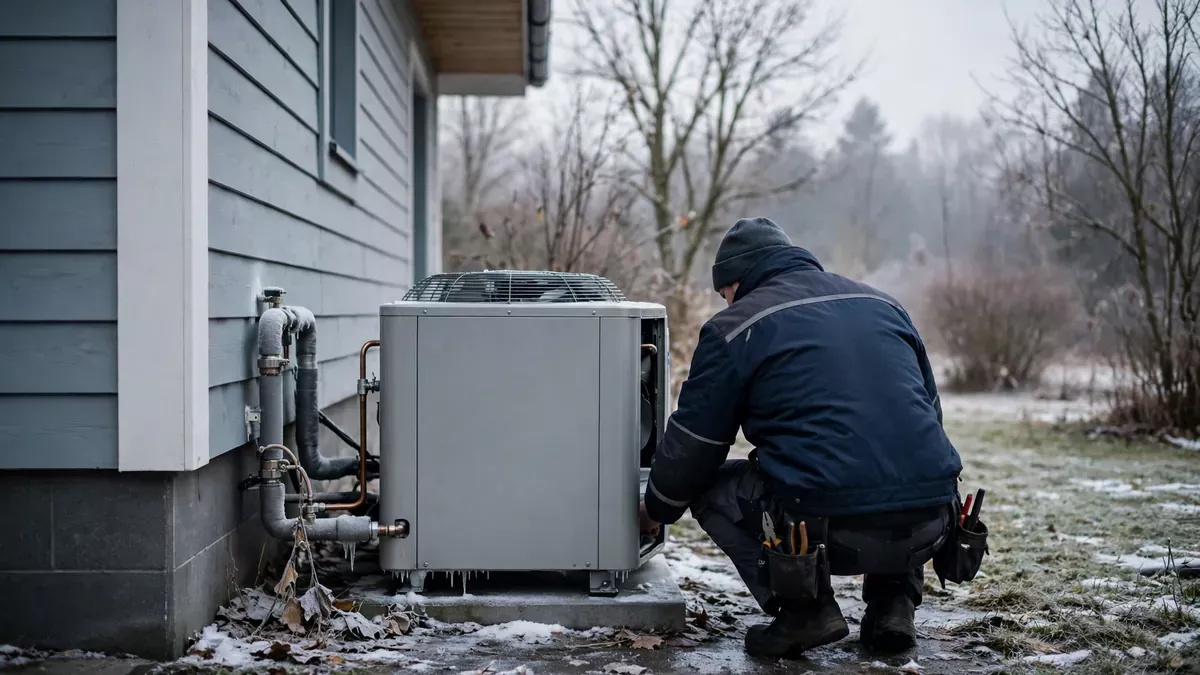
A heat pump does not generate heat. It moves heat. In winter, it extracts heat from the outdoor air, even when the air is cold, and transfers it indoors. In summer, it reverses the process, extracting heat from the indoor air and transferring it outside, cooling the house. A heat pump is, in effect, a reversible air conditioner.
The technology is the same as a refrigerator, which moves heat from inside the fridge to the kitchen. A heat pump uses a refrigerant, a fluid that absorbs heat when it evaporates and releases heat when it condenses, to move heat from one place to another. A compressor circulates the refrigerant, and the system uses electricity to power the compressor and the fans.
Heat pump efficiency is measured differently from furnace efficiency, because a heat pump moves more heat than the electricity it consumes. The ratio is called the coefficient of performance, or COP. A COP of 3 means the heat pump delivers 3 units of heat for every 1 unit of electricity it uses. In mild weather, a heat pump can have a COP of 3 or 4. As the outdoor temperature drops, the COP falls, because there is less heat in the outdoor air to extract.
Heat pumps are also rated by HSPF2, the Heating Seasonal Performance Factor 2, which measures efficiency over an entire heating season. A higher HSPF2 means a more efficient heat pump. The minimum HSPF2 for new heat pumps is set by federal standards, and high-efficiency models exceed it significantly.
The key advantage of a heat pump is that it heats and cools with a single system. If you install a heat pump, you do not need a separate air conditioner. The key disadvantage is that its efficiency depends on the outdoor temperature.
Upfront cost: what you pay to install
A gas furnace typically costs less to install than a heat pump. A standard gas furnace installation, including the unit and labor, often runs in the range of $3,000 to $7,000, depending on the size of the house, the efficiency of the unit, and the complexity of the installation. A high-efficiency condensing furnace costs more, toward the upper end of that range or above.
An air-source heat pump installation typically costs more, often in the range of $4,000 to $8,000 or more for a ducted system, depending on the size, the efficiency, and whether the ductwork needs modification. A ductless mini-split heat pump, which heats and cools individual rooms without ducts, has a different cost structure: the unit itself is less expensive, but installing multiple indoor units adds up.
The comparison is not quite fair, because the heat pump replaces both the furnace and the air conditioner. If you need a new air conditioner as well as a new furnace, the combined cost of the two is comparable to the cost of a heat pump. If your air conditioner is new and working well, the furnace alone is cheaper.
A ground-source heat pump, also called a geothermal heat pump, is a different category. It extracts heat from the ground, where the temperature is stable year-round, rather than from the air. Ground-source heat pumps are the most efficient heating systems available, but they cost much more to install, often $15,000 to $30,000 or more, because they require digging wells or trenches for the ground loop. The payback period is long, but the running costs are very low.
Running cost: what you pay each month
The running cost depends on three things: the price of fuel, the efficiency of the system, and the climate.
In a mild climate, where winter temperatures rarely drop below freezing, a heat pump is usually cheaper to run than a gas furnace. The heat pump operates at a high COP, delivering 3 or more units of heat per unit of electricity, and it rarely needs auxiliary heat. The electricity cost is lower than the gas cost for the same amount of heat.
In a moderate climate, where winter temperatures regularly drop below freezing but rarely below zero, the comparison is closer. The heat pump’s efficiency drops in cold weather, and it may need auxiliary heat on the coldest days. The gas furnace maintains its efficiency regardless of temperature. The winner depends on the local prices of gas and electricity. If gas is cheap and electricity is expensive, the furnace wins. If electricity is cheap and gas is expensive, the heat pump wins.
In a very cold climate, where winter temperatures regularly drop well below freezing, a gas furnace is usually cheaper to run. The heat pump’s COP falls toward 1, meaning it delivers about as much heat as the electricity it consumes, and it relies heavily on auxiliary electric resistance heat, which is the most expensive form of heating. The gas furnace, with its steady AFUE, produces heat at a lower cost.
The exact crossover point depends on your local fuel prices. As a rough guide, a heat pump is cost-competitive with a gas furnace when the price of electricity, in cents per kilowatt-hour, is less than about three times the price of gas, in dollars per therm, adjusted for efficiency. The calculation is approximate, and it varies with the climate and the equipment, but it gives a sense of how the comparison works.
The cold-climate problem and the hybrid solution
The main weakness of a heat pump is cold weather. As the outdoor temperature falls, the heat pump extracts less heat from the air, and its efficiency drops. Below a certain temperature, called the balance point, the heat pump cannot meet the heating demand on its own, and the system switches to auxiliary heat.
Auxiliary heat is usually electric resistance heat, the same technology as a space heater or a toaster. It is 100 percent efficient in the sense that all the electricity becomes heat, but it is expensive, because electricity costs more per unit of heat than gas. A heat pump running on auxiliary heat for extended periods will produce a very high electric bill.
Cold-climate heat pumps address this problem. They are designed to operate efficiently at lower temperatures, down to 5 degrees Fahrenheit or even lower, using variable-speed compressors and improved refrigerants. They cost more than standard heat pumps, but they extend the range in which a heat pump is cost-effective.
A dual-fuel system, also called a hybrid system, is another solution. It pairs a heat pump with a gas furnace. The heat pump handles heating in mild weather, when it is efficient. When the temperature drops below a set point, the system switches to the gas furnace, which is cheaper to run in very cold weather. The dual-fuel system gets the best of both, but it costs more upfront, because you are installing two heating systems.
Lifespan and maintenance
A gas furnace typically lasts 15 to 20 years, sometimes longer with good maintenance. A heat pump typically lasts 10 to 15 years, because it runs year-round, heating in winter and cooling in summer, which means more wear on the compressor and other components. The shorter lifespan is a cost, because you will replace the heat pump sooner.
Both systems need regular maintenance. A furnace needs an annual inspection, a filter change every one to three months, and occasional cleaning of the burners and the heat exchanger. A heat pump needs an annual inspection, a filter change, cleaning of the outdoor unit, and checking the refrigerant level. The maintenance costs are comparable.
Incentives and the total cost
Federal tax credits and utility rebates can significantly reduce the cost of a heat pump. The Inflation Reduction Act created a tax credit for heat pumps, worth up to $2,000 for a qualifying installation, under the Energy Efficient Home Improvement Credit. The credit is available through 2032, though the specific rules and amounts may change. Some states and utilities offer additional rebates.
Gas furnaces generally do not qualify for the same incentives, though some utilities offer rebates for high-efficiency furnaces. The incentive landscape favors heat pumps, which reflects the policy goal of reducing carbon emissions from heating.
When comparing the total cost, add up the upfront cost, minus incentives, plus the expected running cost over the life of the system, plus maintenance. The system with the lowest total cost is the best financial choice, assuming it meets your comfort needs. The calculation depends on your climate, your fuel prices, and how long you plan to stay in the house.
How to decide
Start with your climate. If you live in the southern United States, or in a coastal area with mild winters, a heat pump is likely the better choice. If you live in the northern United States, with long, cold winters, a gas furnace, or a dual-fuel system, is likely the better choice. If you live in the middle, the answer depends on your fuel prices.
Check your fuel prices. Look at your gas and electric bills. If gas is cheap and electricity is expensive, a furnace is more attractive. If electricity is cheap, or if you have solar panels, a heat pump is more attractive.
Consider your existing equipment. If you already have ductwork, a ducted heat pump or a furnace will use it. If you do not have ducts, a ductless mini-split heat pump may be the most practical option. If your air conditioner is old, a heat pump replaces it. If your air conditioner is new, a furnace alone may be cheaper.
Get quotes from several contractors. The installation quality matters as much as the equipment. A poorly sized or poorly installed system, whether a furnace or a heat pump, will be inefficient and uncomfortable. Ask each contractor to perform a load calculation, a method for determining the correct size of the system for your house, rather than guessing based on the size of the old unit.
Frequently asked questions
Can a heat pump work in a very cold climate?
Yes, cold-climate heat pumps are designed to operate at temperatures well below freezing. However, their efficiency drops in extreme cold, and they may need auxiliary heat. In very cold climates, a dual-fuel system, or a gas furnace, is often more cost-effective.
Do I need to replace my ducts for a heat pump?
Not necessarily. A ducted heat pump uses the same ducts as a furnace. However, the ducts should be inspected for leaks and insulation, because a heat pump delivers air at a lower temperature than a furnace, and leaky or uninsulated ducts will lose more of the heat.
Is a heat pump noisier than a furnace?
The outdoor unit of a heat pump makes noise, similar to an air conditioner. The indoor unit is quiet. A furnace is generally quieter, because the combustion and the blower are indoors and insulated. Noise is rarely a deciding factor, but it is worth considering if the outdoor unit will be near a bedroom window.
How long does installation take?
A furnace replacement typically takes one day. A heat pump installation typically takes one to three days, depending on whether the ductwork needs modification, whether a new electrical circuit is needed, and whether the outdoor unit requires a concrete pad.
Will a heat pump increase my electric bill?
Yes, a heat pump uses electricity, so your electric bill will go up. But your gas bill will go down, or disappear, if the heat pump replaces the furnace. The total energy bill, gas plus electric, is what matters, not the electric bill alone.
Sources and further reading
- US Department of Energy: energy.gov: heat pump and furnace efficiency, costs, and how to choose.
- ENERGY STAR: energystar.gov: certified heat pumps and furnaces, efficiency ratings, and rebate information.
- US Energy Information Administration: eia.gov: energy prices, fuel costs, and regional heating trends.
For more on how the systems in your house work, see how your home actually works, and for why your heating costs are what they are, why your heating bill is so high. The cold house problem is covered in why your house is cold at 70 degrees, and our Home & Real Estate section covers more of it.
This article is for general educational and informational purposes only and is not financial, legal, insurance, tax, or medical advice. Always consult a qualified professional regarding your specific situation.