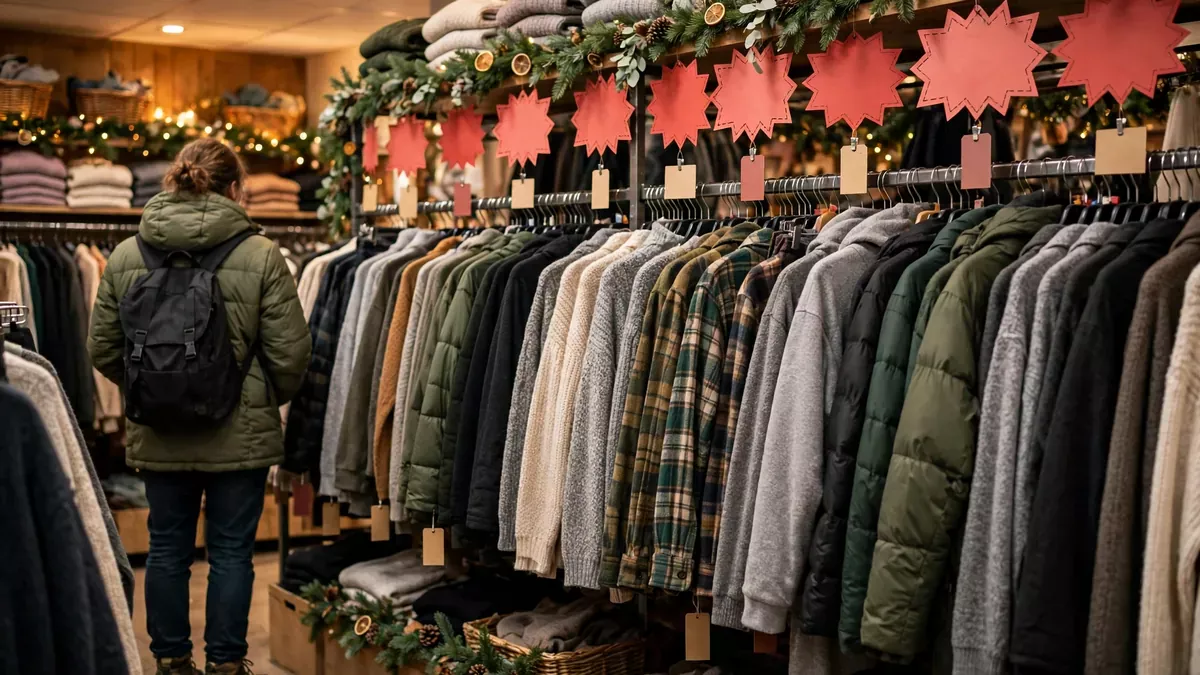
The day after Christmas, the same store that was packed with shoppers a week ago is suddenly quiet. The shelves are still full, but the prices have changed. Tags that read $80 last week now read $40. A week later, they read $25. By the middle of January, the same item might be $15.
It is not generosity. It is math. After Christmas, retailers face a problem: they have too much stuff, and not enough people who want it. The prices drop because the alternative, keeping the inventory, costs more than selling it cheap.
The short answer is this: prices drop after Christmas because retailers need to clear holiday inventory before it becomes worthless, free up shelf space for new products, and turn unsold goods back into cash. The discounts are deepest on seasonal items, and they get deeper the longer the item sits unsold.
Key Takeaways
- Retailers order months of holiday inventory in advance, and whatever does not sell by Christmas Eve is a problem, not an asset.
- Holding unsold inventory costs money: warehouse space, insurance, and capital tied up in goods that are not selling.
- Clearance discounts typically start around 50 percent off and deepen to 70 percent or more by mid-January.
- Seasonal items lose value fastest: holiday decorations, winter clothing, and gift sets are worth far less in January than in December.
- Not everything drops: electronics and everyday essentials often hold their prices, and some “sale” prices are inflated to begin with.
- Gift card redemptions and returns drive January foot traffic, which is why stores run clearance sales instead of just closing the department.
Table of Contents
The inventory problem
Retail is a guessing game. Months before the holidays, buyers at every major retailer have to decide how much of each product to order. They look at last year’s sales, current trends, and forecasts, and they place orders with manufacturers, often in the summer, for goods that will arrive in the fall.
They almost always order too much of something. It is better to have too much than too little: running out of a popular item during the holidays means lost sales that can never be recovered. A store that runs out of the season’s must-have toy on December 15 loses every sale it would have made after that date. So retailers err on the side of overstocking.
The result is that on December 26, stores are sitting on a large pile of unsold holiday merchandise. The National Retail Federation tracks holiday spending each year, and the pattern is consistent: a significant share of holiday inventory remains unsold after Christmas. That inventory is a liability, not an asset, for three reasons.
First, it takes up space. A shelf full of unsold Christmas sweaters is a shelf that cannot hold the spring clothing line, which starts arriving in January. A warehouse full of holiday decorations is a warehouse that cannot hold the next season’s products. Retail space is finite, and every square foot has a cost.
Second, it ties up cash. The retailer has already paid the manufacturer for those goods. Every dollar sitting in unsold inventory is a dollar that cannot be used to buy new products, pay employees, or invest in the business. Selling at a discount, even at a loss, recovers some of that cash.
Third, it loses value. A Christmas decoration is worth something in December and almost nothing in February. Winter clothing is worth less in March than in November. The longer an item sits, the less a customer will pay for it, and the more it costs to store. The rational move is to cut the price early and deeply, while there are still customers willing to buy.
How clearance pricing works
Clearance pricing follows a predictable pattern. The first markdown, usually the day after Christmas, is typically 30 to 50 percent off the original price. This is designed to attract bargain hunters and gift card holders, who are the main customers in the week after Christmas.
If the item still does not sell, the price drops again, usually after a week or two. The second markdown is often 60 to 70 percent off. By mid to late January, a third markdown can take the price to 75 percent off or more. At that point, the retailer is trying to recover any amount, however small, rather than paying to store or dispose of the item.
The timing and depth of the markdowns depend on the product. High-demand items that simply did not sell out, such as popular toys or electronics, may only be discounted modestly, because the retailer knows they will sell at a smaller discount. Low-demand items, or items that are highly seasonal, are discounted aggressively, because the retailer knows they will not sell at all if the price stays high.
Online retailers use a more dynamic version of the same logic. Their pricing algorithms track how fast an item is selling, how much stock remains, and what competitors are charging, and they adjust the price in real time. After Christmas, when demand drops sharply, the algorithms lower prices automatically. This is the same dynamic pricing that raises prices before Black Friday, working in reverse.
Why some prices do not drop
Not everything gets cheaper after Christmas. The pattern applies mainly to holiday-specific and seasonal goods. Several categories behave differently.
Electronics often hold their prices. A television, a laptop, or a smartphone does not become less useful after Christmas, and the retailer knows it will sell at close to full price in January or February. Electronics are also frequently on sale before Christmas, so the post-Christmas price may be the same as the pre-Christmas sale price, or even higher.
Everyday essentials, such as groceries, toiletries, and household supplies, do not follow the clearance pattern at all. Their prices are set by ongoing supply and demand, not by the holiday calendar. A bottle of shampoo costs the same on December 27 as it did on December 20.
Some “sale” prices are misleading. A retailer may raise the original price before Christmas, then “discount” it after Christmas to a price that is close to what the item sold for in November. The Federal Trade Commission has guidance on deceptive pricing, and it warns that a sale price is only a genuine bargain if the original price was the actual price at which the item was sold for a reasonable period before the sale. If the “original” price was never the real price, the discount is an illusion.
Luxury goods and brand-name items are often excluded from clearance sales entirely. The manufacturer may prohibit deep discounting to protect the brand’s image, or the retailer may return unsold luxury items to the manufacturer rather than selling them at a steep discount.
Returns and gift cards: the January economy
Two forces drive January shopping, and both are connected to the post-Christmas price drop.
The first is returns. A large share of holiday gifts are returned in January, either because the recipient did not want them, because they received duplicates, or because the size or color was wrong. The returned items are inspected, and those in good condition are put back on the shelves, often at a discount, because they are no longer in their original packaging or because the retailer wants to move them quickly. Returned items add to the post-Christmas inventory glut.
The second is gift cards. Tens of billions of dollars in gift cards are given each holiday season, and a large share are redeemed in January. Gift card holders are a valuable customer for a retailer: they are spending money the retailer has already received, and they often spend more than the card’s value. Clearance sales are designed in part to attract gift card holders into the store, where they may buy full-price items as well.
Together, returns and gift cards create a January shopping season that is smaller than December but still significant. The US Census Bureau’s retail sales data shows a predictable pattern: a sharp spike in November and December, followed by a drop in January, but with January still well above the summer months. Retailers use clearance pricing to capture as much of that January spending as possible.
What this means for shoppers
If you are a shopper, the post-Christmas period is the best time of year to buy seasonal items for next year. Holiday decorations, wrapping paper, greeting cards, and winter clothing are at their lowest prices in January, and if you have storage space, buying now for next December can save 50 to 75 percent.
It is also a good time to buy items you need anyway, if they happen to be on clearance. A winter coat, a pair of boots, or a set of towels that is marked down 60 percent is a genuine bargain, provided you would have bought it at full price.
It is not a good time to buy something just because it is on sale. A 70 percent discount on something you do not need is not a saving, it is a cost. The clearance sale is designed to make you feel like you are getting a deal, and the feeling can override judgment. The question to ask is not “how much am I saving?” but “would I buy this at full price?”
It is also worth checking the price history. If you are shopping online, a price-tracking tool can show whether the “sale” price is actually lower than the price from a month ago. If the item was cheaper in November than it is in the January “clearance,” the discount is not real.
Frequently asked questions
When do post-Christmas sales start? Most begin on December 26, the day after Christmas. Some online retailers start on Christmas Day itself. The deepest discounts usually appear in mid to late January, when retailers make their final markdowns before clearing the remaining stock.
How low do clearance prices go? It varies by product and retailer, but discounts of 70 to 75 percent off the original price are common by late January for highly seasonal items. Some items may go to 80 or 90 percent off, or be sold in bulk to liquidators. The retailer would rather sell at any price than pay to store or dispose of the item.
Are after-Christmas sales better than Black Friday sales? For seasonal and holiday-specific items, yes. Black Friday discounts are typically 20 to 40 percent off, while post-Christmas clearance can reach 70 percent or more. For electronics and non-seasonal items, Black Friday is usually better, because those items are not heavily discounted after Christmas.
Why do stores not just keep the items until next Christmas? Storage costs money, and the items may be out of style or damaged by next year. A Christmas decoration stored for 11 months takes up warehouse space that could hold products that sell year-round. The cost of storage, insurance, and handling usually exceeds the value of the item by the following December. It is cheaper to sell at a deep discount now than to store for a year.
Do online retailers have the same clearance pattern? Yes, and often more aggressively. Online retailers have lower overhead than physical stores, but they still face the same inventory problem. Their pricing algorithms adjust prices in real time, so online clearance discounts can appear faster and change more frequently than in-store prices.
Sources and further reading
- National Retail Federation: nrf.com: holiday spending data, retail sales trends, and the post-holiday shopping season.
- US Census Bureau: census.gov: monthly retail sales data, including the November, December, and January pattern.
- Federal Trade Commission: ftc.gov: guidance on deceptive pricing and what counts as a genuine sale price.
For more on how the systems behind prices work, see how money works in America, and for the other side of holiday pricing, why Black Friday prices are not what they seem. Holiday spending on credit is covered in why your credit card rate is so high, and our Money & Economics section covers more of it.
This article is for general educational and informational purposes only and is not financial, legal, insurance, tax, or medical advice. Always consult a qualified professional regarding your specific situation.