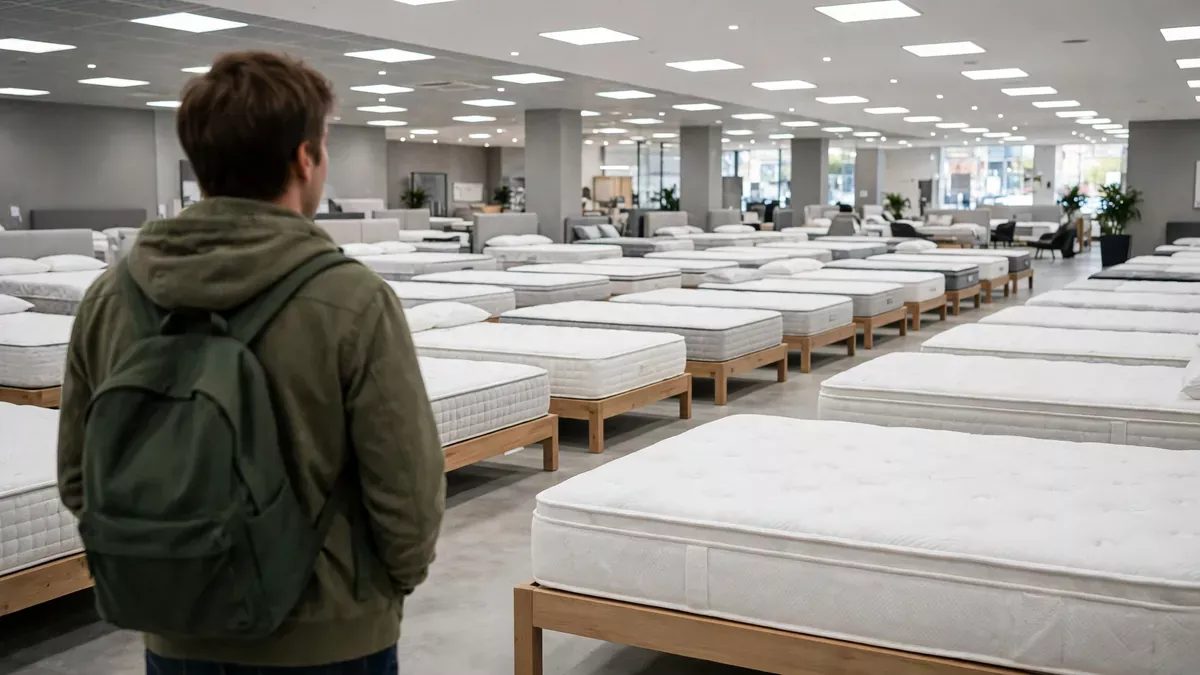
Drive down any commercial road in America, and you will see them: mattress store after mattress store, sometimes two or three on the same block, sometimes directly across the street from each other. The parking lots are nearly empty. The stores are huge. The salespeople are standing by the door, waiting. How do they all stay in business? And why are there so many of them?
The short answer is this: mattress stores survive on enormous profit margins, very low operating costs, and a business model that needs only a few sales a day to pay the rent. The proliferation is the result of aggressive chain expansion in the 2010s, not of overwhelming demand. And no, they are not money laundering fronts, despite what the internet says.
Key Takeaways
- Mattresses have among the highest profit margins in retail, often 40 to 50 percent or more.
- A mattress store needs very little staff, minimal inventory on the floor, and cheap rent in a strip mall.
- People buy a mattress only every 7 to 10 years, so each store needs a large area but only a few sales per day.
- The big chains expanded aggressively in the 2010s, opening stores close together to saturate the market.
- The perpetual sale is a pricing strategy: the “list price” is inflated so the discount looks dramatic.
- The money laundering theory has no evidence behind it. The economics explain the stores.
Table of Contents
The margins: where the money is
The core of the mattress store business is the markup. A mattress that costs a few hundred dollars to manufacture sells for $1,000, $2,000, or more. The gross margin, the difference between the wholesale cost and the retail price, is commonly 40 to 50 percent, and for premium models it can be higher. That is among the highest margins in retail, comparable to jewelry and eyeglasses, and far above the thin margins of grocery stores or electronics.
The high margin exists because mattresses are hard to compare. There is no standard model, no universal specification, and no easy way to tell whether one $1,500 mattress is better than another. Manufacturers make dozens of models with different names for different retailers, so the same basic mattress may be sold under different names at different stores, making price comparison nearly impossible. The customer cannot easily shop around, so the store can maintain a high price.
The margin also covers the cost of the sales model. Mattress stores rely on commissioned salespeople, who guide the customer to a higher-priced model. The salesperson’s commission is built into the margin, as is the cost of delivery, the cost of the showroom, and the cost of advertising. The business works because each sale is worth so much.
A store that sells a $2,000 mattress with a 50 percent margin makes $1,000 in gross profit on a single sale. A few sales a day covers the rent, the staff, and the utilities. A grocery store would need hundreds of customers to make the same profit. That is why the parking lot can be empty and the store can still be open.
The costs: why the stores are so cheap to run
A mattress store is one of the cheapest retail businesses to operate.
The staff is minimal. A typical store has one or two salespeople on the floor at a time, plus a manager. There is no need for cashiers, stockers, or a large team, because the number of customers is low and the transactions are few. The salespeople are often paid partly on commission, which means the labor cost scales with sales.
The inventory on the floor is small. A mattress store displays a few dozen models, but it does not stock hundreds of mattresses in the back. Most orders are fulfilled from a central warehouse, and the mattress is delivered to the customer within a few days. The store is a showroom, not a warehouse.
The rent is low. Mattress stores locate in strip malls, big-box corridors, and suburban commercial roads, where the rent per square foot is far lower than in a prime shopping district or a downtown location. The stores are large, because mattresses take up space, but the space is cheap. A 5,000-square-foot store in a strip mall costs a fraction of what the same space would cost in a mall.
The combination of high margins and low costs means a mattress store can survive on very few sales. Industry estimates suggest that a typical store needs only a handful of sales per day to break even. The empty parking lot is not a sign of failure. It is the normal state of the business.
The expansion: how the chains multiplied
The number of mattress stores exploded in the 2010s, driven by aggressive expansion from the major chains, especially Mattress Firm.
Mattress Firm grew by acquiring competitors and opening new stores, often in locations close to existing ones. The strategy was market saturation: by having a store on every major commercial road, the chain captured customers who wanted to buy locally, and it made it harder for competitors to enter the market. The company also believed that more stores meant more brand visibility, and that visibility would drive sales.
The expansion was funded by debt, and it went too far. Stores opened so close together that they cannibalized each other’s sales. Two Mattress Firm stores on the same road were competing for the same customers, and neither was as profitable as a single store would have been. The company’s leadership later acknowledged that the expansion had been excessive.
In 2018, Mattress Firm filed for Chapter 11 bankruptcy protection and closed hundreds of stores. The bankruptcy filing revealed the scale of the overexpansion: the company had grown to more than 3,500 stores, far more than the market could support. After the restructuring, the company emerged with a smaller footprint, but the stores that remain are still numerous, because the underlying economics still work.
Other chains followed a similar pattern, though on a smaller scale. The result is the landscape you see today: many stores, often clustered together, each surviving on a few sales a day.
The clustering: why they are next to each other
Mattress stores cluster together for the same reason car dealerships cluster together: comparison shopping.
When a customer decides to buy a mattress, they typically visit several stores in one trip. They want to lie on different models, compare prices, and get a sense of what is available. A cluster of stores makes that easy. The customer drives to the mattress district, visits three or four stores, and buys from one of them.
For the stores, being near competitors is a benefit, not a drawback. A lone mattress store on a quiet road gets less foot traffic than a store in a cluster, because the cluster attracts customers who are already in buying mode. The stores share the customer flow, and each one hopes to win the sale.
The clustering is also driven by real estate. Mattress stores need large, cheap spaces with good road visibility and easy parking. Those spaces are concentrated in the same commercial corridors, which is why the stores end up next to each other. The location that works for one mattress store works for all of them.
The perpetual sale
Every mattress store is always having a sale. Presidents’ Day sale, Memorial Day sale, Labor Day sale, Black Friday sale, clearance sale, going out of business sale. The discounts are dramatic: 50 percent off, 60 percent off, buy one get one free. The sale never ends.
The perpetual sale is a pricing strategy. The list price of a mattress is set high, far above what the store expects to receive. The sale price is the real price, and it still includes a healthy margin. The discount creates urgency: the customer feels they are getting a deal, and they are more likely to buy now rather than wait.
The strategy works because mattresses are a low-frequency purchase. Most customers do not know what a mattress should cost, because they buy one so rarely. They have no reference price, so the list price becomes the anchor, and the sale price looks like a bargain. A customer who sees a $3,000 mattress marked down to $1,500 feels they have saved $1,500, even if the mattress was never going to sell for $3,000.
Holiday weekends are the peak sales periods for mattresses, which is why the biggest sales coincide with Presidents’ Day, Memorial Day, the Fourth of July, and Labor Day. These are the weekends when people have time to shop, and when the stores run their most aggressive promotions. The pattern is so established that mattress industry analysts track holiday weekend sales as a key indicator.
The conspiracy theory
In 2018, a post on Reddit asked a question that went viral: are mattress stores a front for money laundering? The reasoning was that there were too many stores, they were always empty, and the business did not seem to make sense. The post was shared widely, and the theory became a popular piece of internet folklore.
There is no evidence for it. No investigation, no prosecution, and no credible reporting has found that mattress stores are used for money laundering on any significant scale. The economics of the business, high margins and low costs, fully explain why the stores exist and why they appear empty.
The theory persists because it feels like an explanation for something that looks strange. A row of empty stores selling an expensive product that people rarely buy does look odd, if you do not know the margins. But the oddness is a feature of the business model, not a cover for a crime.
The Mattress Firm bankruptcy, which happened the same year the theory went viral, fueled the speculation, because the company’s finances were messy and its expansion had been reckless. But the bankruptcy filings showed a company that had expanded too aggressively on borrowed money, not a money laundering operation. The accounting issues were real, but they were about overstated earnings and aggressive growth, not about illicit funds.
The online disruption
The mattress store landscape is changing. Online mattress companies, often called bed-in-a-box brands, have disrupted the traditional model by selling directly to consumers, shipping a compressed mattress in a box, and offering long trial periods with free returns.
The online brands have lower costs than physical stores: no showroom, no commissioned salespeople, no retail rent. They pass some of the savings to the customer, and they have forced traditional stores to compete on price and convenience. Some traditional chains have responded by launching their own online brands, or by offering online ordering with in-store pickup.
The disruption has led to store closures, but it has not eliminated the physical store. Many customers still want to lie on a mattress before buying it, and the trial period, while generous, requires the customer to receive, unbox, and potentially return a large item. The physical store offers immediacy and certainty that the online model cannot match.
The likely future is a hybrid: fewer stores, each one more focused on the customer experience, alongside a growing online channel. The era of a mattress store on every corner is ending, but the mattress store itself is not disappearing.
What this means for you
If you are buying a mattress, the economics work in your favor, if you know how to use them.
Negotiate. The margin is high, which means there is room to move. Ask for a discount, and be prepared to walk away. The salesperson would rather make a smaller profit than lose the sale. A 10 to 20 percent discount off the sale price is often achievable, especially at the end of the month, when salespeople are trying to hit targets.
Compare across stores, but remember that model names are often unique to each retailer. Compare the specifications instead: the type of mattress (innerspring, memory foam, hybrid), the firmness, the materials, and the warranty. Those are the real differences.
Check the return policy. Most stores offer a trial period, typically 30 to 120 days, during which you can return or exchange the mattress. Read the terms: some trials have a minimum break-in period, some charge a restocking fee, and some require you to keep the mattress for a certain number of nights before returning it.
Do not be rushed by the sale. The sale will still be there next weekend, and the weekend after that. Take your time, visit multiple stores, and buy when you are ready, not when the salesperson tells you the deal expires.
Frequently asked questions
How often should I replace my mattress?
Most manufacturers and sleep experts suggest replacing a mattress every 7 to 10 years, depending on the type, the quality, and how well you have cared for it. Signs that it is time include visible sagging, waking up with aches, or sleeping better in a different bed.
Are expensive mattresses worth it?
Not necessarily. Price and quality are correlated, but the relationship is weak above a certain point. A $1,000 mattress is generally better than a $300 mattress, but a $3,000 mattress is not necessarily better than a $1,500 one. The best mattress is the one that fits your body, your sleeping position, and your budget.
Why do mattress stores have such high-pressure sales tactics?
The commission structure incentivizes salespeople to close the sale on the spot, because a customer who leaves is unlikely to return. The pressure is a consequence of the low-frequency purchase: the store has one chance to win your business for the next decade, and the salesperson’s income depends on it.
Is it better to buy online or in a store?
It depends on what you value. In a store, you can test the mattress and take it home the same day. Online, you get a longer trial period, a lower price, and the convenience of home delivery, but you cannot test before you buy. Many people do both: test in a store, then buy online, though this is not the most ethical approach.
What happens to returned mattresses?
It depends on the retailer. Some returned mattresses are sanitized and resold as clearance or open-box items. Some are donated to charity. Some are recycled: the steel springs, foam, and fabric can be separated and reused. The specific policy varies by retailer and by state law.
Sources and further reading
- Consumer Financial Protection Bureau: consumerfinance.gov: understanding prices, sales tactics, and how to shop wisely.
- Federal Trade Commission: consumer.ftc.gov: advertising rules, pricing practices, and consumer rights.
- US Census Bureau: census.gov: retail data, business counts, and how the retail landscape changes.
For more on the hidden systems behind everyday life, see the everyday systems that run your life, and for the money behind the mattress, how money works in America. The pricing tricks are covered in why Black Friday prices are not what they seem, and our Curiosity section covers more of it.
This article is for general educational and informational purposes only and is not financial, legal, insurance, tax, or medical advice. Always consult a qualified professional regarding your specific situation.