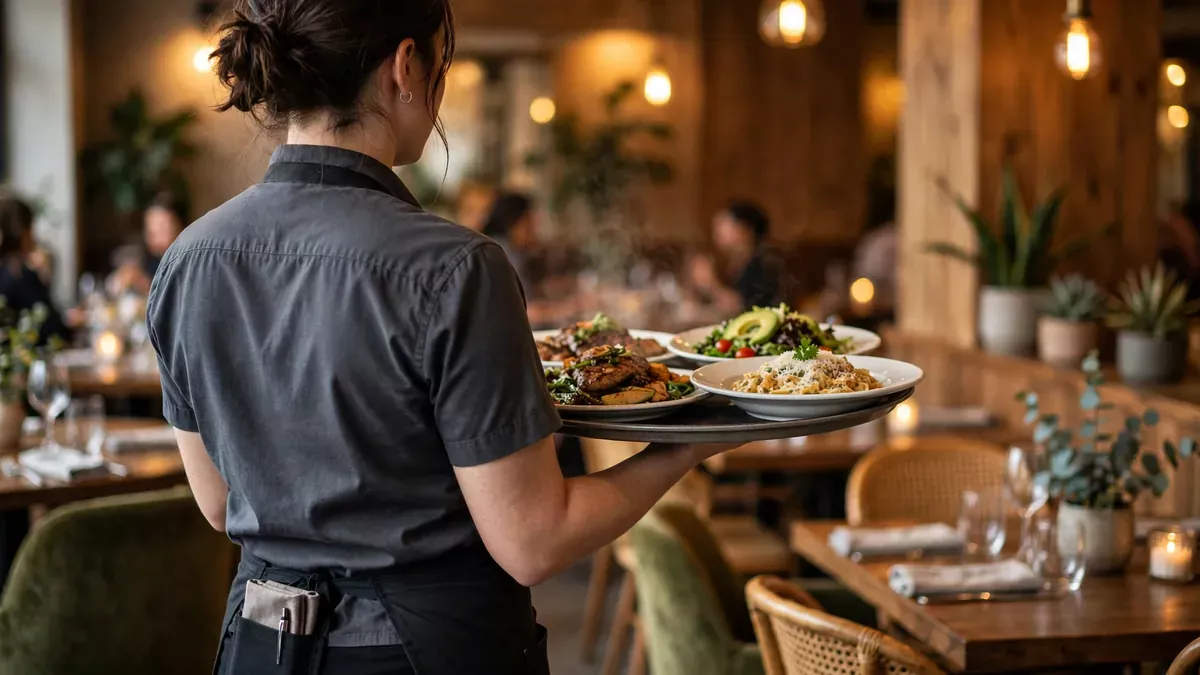
You finish a meal at a restaurant. The bill arrives. At the bottom, there is a blank line for a tip, and a set of suggested percentages: 18, 20, 25 percent. You do the math, add the tip, and sign. The whole ritual takes ten seconds, and it feels as natural as the meal itself.
But it is not natural. It is a custom, and a strange one. In most of the world, the price on the menu is the price you pay, and the server is paid a wage by the employer. In America, the customer pays the server directly, in an amount that is technically voluntary but socially mandatory. How did this happen? And why does it persist, when so many people complain about it?
The short answer is this: tipping spread in America after the Civil War, when employers used it as a way to avoid paying wages to Black service workers. It survived because the restaurant industry lobbied to keep it, and because the law still allows employers to pay tipped workers a lower minimum wage. It persists because the system is now deeply embedded in how restaurants operate, how servers are paid, and how customers think about the price of a meal.
Key Takeaways
- The federal tipped minimum wage is $2.13 per hour, unchanged since 1991. Employers must make up the difference if tips plus $2.13 fall below the federal minimum wage of $7.25.
- Seven states have no tip credit: California, Oregon, Washington, Nevada, Minnesota, Montana, and Alaska. In those states, tipped workers earn the full state minimum wage plus tips.
- Tipping spread after the Civil War, when employers, notably the Pullman Company, hired Black workers at little or no pay and told them to rely on tips.
- Several states banned tipping in the late nineteenth and early twentieth centuries. The bans were later repealed, in part because of industry lobbying.
- Customary tip amounts have risen over time, from about 10 percent in the mid-twentieth century to 18 to 20 percent today.
- Tips are taxable income. Servers are required to report them, and the IRS has enforcement mechanisms for unreported tips.
Table of Contents
Where tipping came from
Tipping originated in Europe, where it was a small gratuity given to servants and service workers, a token of appreciation rather than a primary source of income. The practice crossed the Atlantic in the nineteenth century, when wealthy Americans returned from European trips and brought the custom with them. It was initially controversial: many Americans saw tipping as undemocratic, a European aristocratic practice that had no place in a republic. Newspaper editorials denounced it. Anti-tipping societies formed.
But the custom found fertile ground in a specific context: the post-Civil War economy. After emancipation, millions of Black Americans entered the labor market, and many found work in service industries: as waiters, porters, bellhops, and domestic workers. Employers in these industries, notably the Pullman Company, which operated sleeping cars on trains, hired Black workers and paid them little or nothing, telling them to rely on tips from customers. The Pullman porter became an iconic figure in American service work, and the tip became the primary source of his income.
The arrangement served the employers. It kept labor costs low, and it shifted the burden of paying workers onto the customer. It also had a racial dimension that is hard to ignore: the workers who were expected to live on tips were disproportionately Black, and the customers who were expected to tip them were disproportionately white. The custom was, from the start, entangled with the racial hierarchy of the postwar South.
Tipping spread from there. As the restaurant industry grew in the late nineteenth and early twentieth centuries, tipping became the standard way to pay servers. The custom was not universal, and it was not uncontested, but it became the norm.
The bans that failed
Tipping was controversial enough that several states tried to ban it. Between the 1890s and the 1910s, six states passed laws prohibiting tipping: South Carolina, Georgia, Tennessee, Mississippi, Iowa, and Washington. The laws were driven by a mix of concerns: that tipping was undemocratic, that it encouraged servility, and that it allowed employers to underpay workers.
The bans did not last. They were difficult to enforce, because tipping was a private transaction between a customer and a server. They were unpopular with servers, who depended on tips for income and who saw the bans as a threat to their livelihood. And they were opposed by the restaurant and hospitality industries, which had a financial interest in keeping the tip system.
By the 1920s, all of the bans had been repealed. The last to go was Iowa, in 1926. After that, no state tried to ban tipping again. The custom was entrenched, and the legal framework shifted from prohibition to regulation.
The federal government entered the picture with the Fair Labor Standards Act of 1938, which established the first federal minimum wage. The original act did not cover tipped workers in the same way as other workers, and the tip credit, the provision that allows employers to pay tipped workers less than the minimum wage, was formalized in the 1966 amendments. The tipped minimum wage was set at 50 percent of the regular minimum wage, and it was later frozen at $2.13 per hour in 1991, where it has remained ever since.
How the tip credit works
The federal tipped minimum wage is $2.13 per hour. The federal minimum wage is $7.25 per hour. The difference, $5.12 per hour, is the maximum tip credit: the amount the employer can count tips toward the minimum wage obligation.
Here is how it works in practice. A server earns $2.13 per hour in wages from the employer, plus tips from customers. If the server’s tips, added to the $2.13 wage, equal or exceed $7.25 per hour, the employer has met its obligation. If the tips fall short, the employer must make up the difference, so that the server’s total pay is at least $7.25 per hour.
In theory, the tip credit guarantees that tipped workers earn at least the minimum wage. In practice, the guarantee is difficult to enforce. The employer is responsible for tracking tips and making up any shortfall, but the tracking is often imperfect, and servers may not know their rights or may be reluctant to complain. The Department of Labor has found widespread violations in the restaurant industry, including employers who fail to make up the shortfall, employers who take a share of tips for themselves, and employers who require servers to share tips with workers who are not legally eligible to receive them.
Seven states have abolished the tip credit entirely: California, Oregon, Washington, Nevada, Minnesota, Montana, and Alaska. In those states, tipped workers earn the full state minimum wage, plus tips on top. The state minimum wage in those states is often higher than the federal minimum, so the base pay is significantly higher than $2.13. The restaurant industry in those states has not collapsed, which is sometimes cited as evidence that the tip credit is not necessary for the industry to survive.
Other states have a tip credit, but with a higher tipped minimum wage than the federal $2.13. The specific amounts vary by state, and they change over time. The federal $2.13 is the floor, not the ceiling.
Why the percentages keep rising
Customary tip amounts have risen steadily over the decades. In the mid-twentieth century, a 10 percent tip was standard. By the 1980s, 15 percent was the norm. Today, 18 to 20 percent is the standard suggestion at a sit-down restaurant, and the suggested percentages on payment screens often start at 20 percent and go up to 25 or 30 percent.
There are several reasons for the increase. Inflation is one: as prices rise, a fixed percentage yields more dollars, but the percentage itself has also risen. The expansion of tipping to new contexts is another: tip prompts now appear at coffee shops, food trucks, self-service kiosks, and delivery apps, where tipping was once uncommon. The social pressure to tip has increased, because the suggested amounts are displayed prominently and the option to tip less, or not at all, requires an active choice.
The rise in suggested percentages is also driven by the technology of payment. When a customer paid in cash, they calculated the tip themselves, and the amount was private. When a customer pays by card, the payment screen presents a set of options, and the customer selects one. The options are chosen by the business, and they tend to start high. The customer can enter a custom amount, but that requires extra effort, and many people choose one of the presented options.
The phenomenon has a name: tip fatigue. Many Americans report feeling overwhelmed by the number of tip requests they encounter, and resentful of the expectation to tip in contexts where tipping was once unnecessary. The fatigue is real, but it has not led to a decline in tipping. The social norm is strong, and the fear of being judged for tipping too little, or not at all, keeps the custom alive.
What the research says
The relationship between service quality and tip size is weaker than most people assume. Studies have consistently found that the correlation between how well a server performs and how much they are tipped is modest. Customers tip based on habit, on social norms, on the size of the bill, and on factors that have little to do with service quality, such as the server’s appearance, friendliness, or gender.
The finding is not surprising, given how tipping works. The customer decides the tip at the end of the meal, after the service is complete. The tip is a single number, and it reflects the entire experience: the food, the ambiance, the wait time, the server’s demeanor. It is a blunt instrument for rewarding good service.
The research also shows that tipping creates income inequality among servers. Servers who work busy shifts, at expensive restaurants, in affluent areas, earn far more in tips than servers who work slow shifts, at inexpensive restaurants, in poorer areas. The difference is not based on skill or effort. It is based on the luck of the assignment.
Tipping also creates a power dynamic between the customer and the server. The server depends on the customer’s generosity for income, which can lead to tolerating rude or abusive behavior. The customer, in turn, may feel entitled to special treatment because they are paying the server directly. The dynamic is a source of tension in the industry.
The alternatives
Other countries handle service pay differently. In most of Europe, the price on the menu includes a service charge, or the server is paid a full wage by the employer. Tipping is a small extra, a rounding up or a few euros, not a primary source of income. In Japan, tipping is not customary at all, and it can be seen as rude. In Australia, tipping is optional and uncommon.
Some American restaurants have experimented with alternatives. A few have eliminated tipping and raised menu prices, paying servers a higher wage. The experiments have had mixed results. Some restaurants found that customers were confused by the higher prices, or that servers left for tipped jobs where they could earn more. Others found that the model worked, and that it improved morale and reduced turnover.
The no-tipping model faces a structural challenge: as long as tipping is the norm, a restaurant that eliminates tipping must raise its prices to pay higher wages, which makes it look more expensive than its competitors. The customer sees a $25 entree at the no-tipping restaurant and a $20 entree at the tipping restaurant, and they may not realize that the $20 entree will cost $24 after a 20 percent tip. The price comparison is not apples to apples.
A service charge is a middle ground. Some restaurants add a mandatory service charge, typically 18 to 20 percent, to the bill, and use it to pay all staff, including kitchen workers, who are not eligible for tips under federal law. A service charge is not a tip: it is a fee, and the restaurant can distribute it as it chooses. The distinction matters legally, because tips belong to the employee, while a service charge belongs to the employer.
What this means for you
If you are a customer, the practical guidance is straightforward. At a sit-down restaurant, 18 to 20 percent is the current standard for adequate service. Tip more for exceptional service, and less if the service was genuinely poor, though it is worth distinguishing between problems caused by the server and problems caused by the kitchen or the restaurant. A long wait for food is often the kitchen’s fault, not the server’s.
For takeout, delivery, and counter service, the norms are less settled. A small tip, 10 to 15 percent, is common for delivery, and a few dollars is common for takeout. At a coffee shop or a food truck, tipping is optional, and many people tip a dollar or round up.
If you are a server, know your rights. Your employer must ensure that your total pay, wages plus tips, is at least the minimum wage. Your employer cannot take your tips for itself. Your employer can require tip pooling, sharing tips among eligible employees, but only under specific rules that depend on whether the employer takes a tip credit. If you believe your employer is violating the law, you can file a complaint with the Department of Labor’s Wage and Hour Division.
Tips are taxable income. You are required to report them on your tax return. The IRS has enforcement mechanisms for unreported tips, including estimating tip income based on the restaurant’s sales. The rules are complex, and a tax professional can help if you have questions.
Frequently asked questions
Is tipping legally required? No. Tipping is voluntary, in the legal sense. You cannot be arrested or sued for not tipping, unless the restaurant has a mandatory service charge, which is a fee, not a tip. But tipping is a strong social norm, and not tipping is widely seen as rude.
Why is the tipped minimum wage still $2.13? The tipped minimum wage has been frozen at $2.13 since 1991 because Congress has not raised it. The regular minimum wage was last raised in 2009, to $7.25. Efforts to raise the tipped minimum wage, or to eliminate the tip credit, have been blocked in Congress, in part because of opposition from the restaurant industry.
Do servers prefer tipping or a higher wage? It depends on the server and the restaurant. Servers at busy, expensive restaurants often earn more from tips than they would from a flat wage, and they prefer the tip system. Servers at slow, inexpensive restaurants often earn less, and they would prefer a higher wage. There is no consensus in the industry.
What is tip pooling? Tip pooling is a system in which servers share their tips with other employees, such as bussers, food runners, and bartenders. Federal law allows tip pooling, but the rules depend on whether the employer takes a tip credit. If the employer takes a tip credit, only traditionally tipped employees can participate in the pool. If the employer pays the full minimum wage, the pool can include back-of-house workers, such as cooks and dishwashers.
Should I tip on the pre-tax or post-tax amount? The customary practice is to tip on the pre-tax subtotal, though many people tip on the post-tax total for simplicity. The difference is small, a few cents on a typical bill, and either approach is acceptable.
Sources and further reading
- US Department of Labor: dol.gov: the tipped minimum wage, the tip credit, and your rights as a tipped worker.
- Internal Revenue Service: irs.gov: how tips are taxed, reporting requirements, and the rules for tip pooling.
- US Bureau of Labor Statistics: bls.gov: wages, employment, and working conditions in the food service industry.
For more on the hidden systems behind everyday life, see the everyday systems that run your life, and for the money behind the custom, how money works in America. The sounds of the restaurant are covered in why stores play music, and our Curiosity section covers more of it.
This article is for general educational and informational purposes only and is not financial, legal, insurance, tax, or medical advice. Always consult a qualified professional regarding your specific situation.