Your electric car shows 250 miles of range in October. In January, the same car, fully charged, shows 180. Nothing is wrong with it. The battery did not degrade overnight. Cold weather changes how a lithium-ion battery works, how the car heats the cabin, and how fast it can charge, and the combined effect is the winter range loss every EV owner notices.
The short answer is this: an EV loses range in winter because cold slows the battery’s chemistry, because heating the cabin draws power from the same battery that drives the wheels, and because cold batteries charge more slowly. The loss is temporary, and it disappears when the weather warms up.
Key Takeaways
- Cold slows the chemical reactions inside a lithium-ion battery, reducing the power it can deliver and the energy it can accept.
- Cabin heating is often the single biggest cause of winter range loss, because an EV has no waste engine heat to use for free.
- Range loss varies widely, commonly 10 to 40 percent, depending on temperature, the car model, and how much heat you use.
- Cold batteries charge more slowly, especially at DC fast chargers. Preconditioning the battery before charging helps.
- The winter range loss is temporary. It is not permanent battery damage, and the range returns in spring.
- Preconditioning the cabin while plugged in, using seat heaters instead of cabin heat, and parking in a garage all help preserve range.
Table of Contents
The battery chemistry problem
A lithium-ion battery stores and releases energy through chemical reactions. Lithium ions move between the anode and the cathode through an electrolyte, and that movement is what creates electric current. Like all chemical reactions, this one is temperature-sensitive. Cold slows it down.
In cold weather, the electrolyte thickens, the internal resistance of the battery rises, and the ions move more slowly. The battery can still store the same amount of energy, but it cannot deliver it as quickly or as completely. The car’s battery management system limits the power output to protect the battery, which means less acceleration and less available range.
The effect is most noticeable at very low temperatures. At 32 degrees Fahrenheit, the loss is modest. At 0 degrees, it is substantial. The exact numbers depend on the battery chemistry, the car’s thermal management system, and how cold it gets, but the direction is consistent: colder means less usable range.
This is not damage. The battery is not degraded by cold weather in normal use. The chemical reactions slow down, but they do not stop, and they return to normal when the battery warms up. The range you lose in January comes back in April. The car is protecting the battery by limiting what it does in the cold, not wearing it out.
One real risk does exist: charging a very cold battery at high speed can cause lithium plating, a process in which lithium metal deposits on the anode instead of intercalating into it. Over time, plating reduces battery capacity permanently. This is why EVs limit charging speed when the battery is cold. The car is not being slow for no reason. It is protecting the battery from damage.
The heating problem
The bigger cause of winter range loss, for most drivers, is not the battery chemistry. It is the heater.
A gasoline car produces an enormous amount of waste heat. Only about 20 to 30 percent of the energy in gasoline becomes motion. The rest becomes heat, most of which is wasted through the radiator and exhaust. Heating the cabin in a gas car is free, because the heat is already there. You are just redirecting it.
An electric car is far more efficient. About 80 to 90 percent of the energy from the battery becomes motion. There is almost no waste heat. To warm the cabin, the car must use a heater, and that heater draws power from the same battery that drives the wheels. Every kilowatt-hour spent on heat is a kilowatt-hour not spent on driving.
A resistive heater, the type used in many older EVs, draws 3 to 7 kilowatts when running at full power. Over an hour of driving, that is 3 to 7 kilowatt-hours, which is 10 to 25 percent of a typical EV battery’s capacity. In stop-and-go city driving, where the car is moving slowly and the heater runs continuously, the heating load can exceed the driving load.
Heat pumps solve much of this problem. A heat pump does not generate heat. It moves heat from the outside air into the cabin, using a refrigeration cycle in reverse. A heat pump can deliver 2 to 3 units of heat for every unit of electricity it consumes, compared to 1 unit for a resistive heater. Many newer EVs use heat pumps, and they lose significantly less range in winter than EVs with resistive heaters. If you are shopping for an EV and you live in a cold climate, a heat pump is one of the most valuable features to look for.
How much range do you actually lose?
The answer depends on the temperature, the car, and how you drive. At mild cold, around 40 degrees, the loss is small, perhaps 5 to 10 percent. At 20 degrees, with the heater running, the loss is larger. At 0 degrees or below, it can be substantial.
AAA tested five EVs in 2019 and found that at 20 degrees Fahrenheit, with the heater on, the average range loss was about 41 percent compared to testing at 75 degrees. Without the heater, the loss was about 12 percent, which isolates the battery chemistry effect from the heating effect. The study is a few years old, and newer EVs with heat pumps perform better, but the pattern holds: the heater is the bigger factor.
Real-world data from EV owners and fleet telematics companies shows a similar range. Most drivers report winter range losses of 10 to 30 percent in moderate cold, and 30 to 40 percent in extreme cold with heavy heating use. The variation between models is large, because battery size, thermal management, heat pump availability, and cabin insulation all differ.
The US Department of Energy notes that cold weather reduces EV range, and advises drivers to expect lower range in winter and to plan charging stops accordingly. The EPA range rating on the window sticker is measured at moderate temperatures and does not account for winter conditions.
Charging slows down too
Cold affects charging as well as driving. A cold battery accepts charge more slowly, because the same slowed chemistry that limits power output also limits power input. At a DC fast charger, a cold battery may charge at half its normal rate, or less, for the first part of the session. The charging speed improves as the battery warms up, either from the charging process itself or from the car’s battery heater.
Preconditioning solves this. Most EVs can warm the battery before you arrive at a fast charger, either automatically when you navigate to a charger using the car’s built-in navigation, or manually through the car’s settings. Preconditioning uses energy from the battery to heat it, which costs some range, but it saves more time at the charger than it costs in range. If you are planning a winter road trip, set the charger as your destination in the car’s navigation, and let it precondition.
Home charging is less affected, because Level 2 home charging is slow enough that the battery can accept it even when cold. But charging will still take longer in winter, and the car may use some of the charging energy to warm the battery first. If you charge overnight, the extra time does not matter.
Regenerative braking is also reduced in cold weather. When you lift off the accelerator, the car normally recovers energy by using the motor as a generator. A cold battery cannot accept that energy as quickly, so the car limits regenerative braking. You may notice the car coasts more freely and the brake pedal feels different in winter. This is normal, and it returns to normal when the battery warms up.
What actually helps
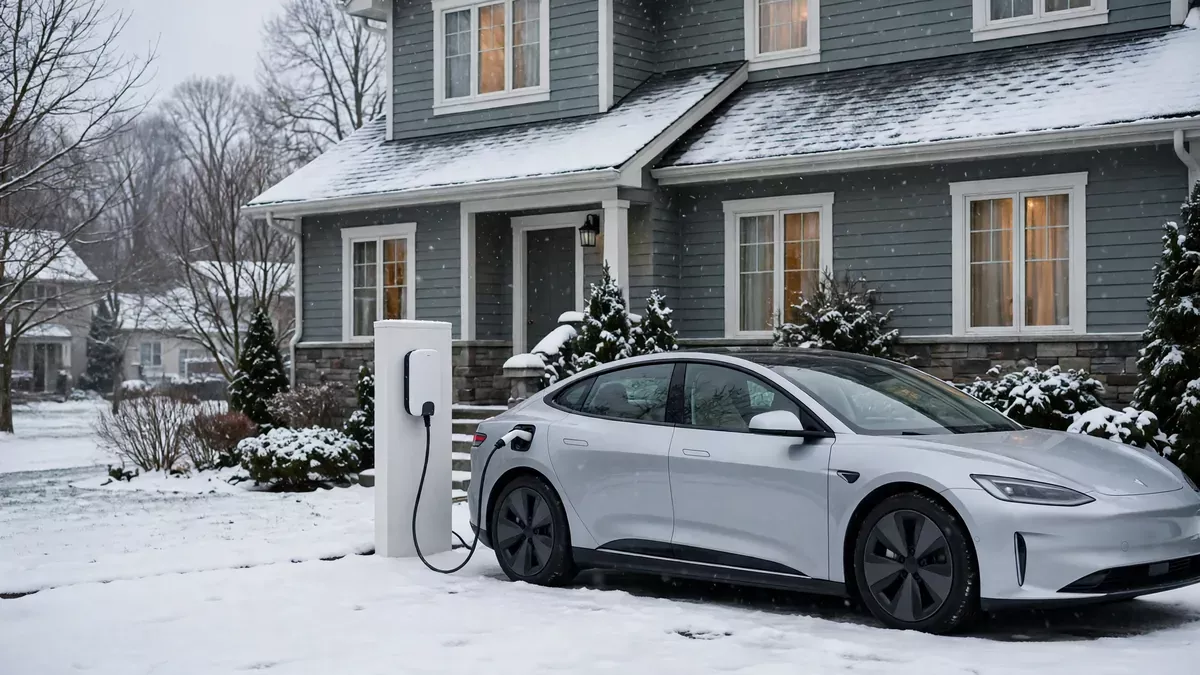
The most effective step is to precondition the cabin while the car is still plugged in. Use the car’s app or schedule to warm the cabin before you leave, while the car is connected to the charger. The energy comes from the wall, not the battery, so you start your trip with a warm cabin and a full charge.
Use seat heaters and the heated steering wheel instead of the cabin heater, when you can. A seat heater draws about 50 to 100 watts. A cabin heater draws thousands of watts. Heating your body directly is far more efficient than heating the entire cabin volume. Many EV owners find that seat heaters plus a low cabin temperature setting are comfortable and use much less energy.
Park in a garage if you have one. A garage is warmer than the outdoors, which keeps the battery warmer and reduces the energy needed to warm the cabin. Even an unheated garage is several degrees warmer than outside, and that difference matters.
Keep the car plugged in overnight in extreme cold. The car’s battery management system will use wall power to keep the battery at a safe temperature, which preserves range and protects the battery. This is especially important if temperatures drop well below freezing.
Check your tire pressure. Cold air reduces tire pressure, and underinflated tires increase rolling resistance, which reduces range in any car. Check the pressure monthly in winter, and inflate to the pressure listed on the driver’s door jamb, not the maximum on the tire sidewall.
Plan charging stops with extra margin in winter. If your summer road trip needs one charging stop, your winter trip may need two, or a longer stop. Build the extra time into your schedule rather than discovering it on the road.
Gas cars lose efficiency in winter too
It is worth noting that gasoline cars also lose efficiency in cold weather. A cold engine runs less efficiently until it warms up. Winter gasoline blends contain less energy per gallon. Cold air is denser, which increases aerodynamic drag. Short trips, where the engine never fully warms up, are especially inefficient. The US Department of Energy estimates that a conventional gasoline car can lose 10 to 20 percent of its fuel economy in cold weather, and more on short trips.
The difference is that gas car drivers rarely notice, because they do not watch a range display as closely, and because refueling takes five minutes. An EV driver notices winter range loss because the dashboard shows it, and because charging takes longer. The physics affects both. The visibility is different.
Frequently asked questions
Will winter permanently damage my EV battery?
No, not in normal use. Cold temporarily reduces the battery’s performance, but it does not cause permanent degradation. The car’s battery management system limits charging speed in the cold specifically to prevent damage. The range returns when temperatures rise.
Should I charge to 100 percent in winter?
For daily driving, the usual guidance applies: charge to 80 percent for battery longevity, and charge to 100 percent only when you need the extra range for a long trip. In winter, the extra range from a full charge can be useful on cold days. The battery management system handles the rest.
Does a heat pump make a big difference?
Yes. A heat pump is 2 to 3 times more efficient than a resistive heater, which means it uses one-half to one-third as much energy to produce the same amount of cabin heat. In winter, that difference can mean 10 to 15 percent more range. If you are buying an EV for a cold climate, prioritize a heat pump.
Why does my EV charge so slowly in winter?
The battery is cold, and the car limits charging speed to protect it. Preconditioning the battery before arriving at a fast charger helps significantly. If your car does not precondition automatically, check whether you can trigger it manually through the app or the car’s settings.
Is an EV a bad choice if I live in a cold climate?
Not necessarily. Millions of EVs operate in Norway, Canada, and the northern United States. The winter range loss is real, but it is manageable with preconditioning, a heat pump, and realistic expectations. If your daily driving is well within the car’s winter range, and you can charge at home, an EV works fine in cold weather. If you regularly drive long distances in extreme cold with limited charging infrastructure, a gas car or a plug-in hybrid may be more practical.
Sources and further reading
- US Department of Energy: energy.gov: how cold weather affects EV range and charging, and tips for winter driving.
- FuelEconomy.gov: fueleconomy.gov: EV range, fuel economy, and how temperature affects efficiency.
- National Highway Traffic Safety Administration: nhtsa.gov: EV safety, battery information, and winter driving guidance.
For more on how cars and their costs work, see how cars, insurance, and travel costs work, and for how heating works in your home, how your home works. The technology behind batteries connects to how the internet and your devices work, and our Auto & Travel section covers more of it.
This article is for general educational and informational purposes only and is not financial, legal, insurance, tax, or medical advice. Always consult a qualified professional regarding your specific situation.