It is the coldest night of the winter. You wake up to a sound you have never heard before: water, running where it should not be. A pipe has burst. Water is pouring into the basement, or the kitchen, or the wall cavity. The damage is already done, and it is going to be expensive.
A burst pipe is one of the most common and most costly winter home disasters. It is also one of the most preventable, if you understand why pipes freeze and burst, and what to do about it.
The short answer is this: water expands when it freezes, by about 9 percent. When water freezes inside a pipe, the expanding ice creates pressure. The pipe does not burst at the ice blockage, as most people assume. It bursts downstream, where the pressure builds up between the ice and a closed faucet. The burst is caused by pressure, not by the ice itself.
Key Takeaways
- Water expands by about 9 percent when it freezes. That expansion creates enormous pressure inside a pipe.
- Pipes usually burst downstream of the ice blockage, not at the ice itself, because the pressure builds between the ice and a closed faucet.
- The pipes most at risk are in exterior walls, unheated crawl spaces, attics, garages, and cabinets on exterior walls.
- Pipes can freeze when temperatures drop below 20 degrees Fahrenheit, especially if the cold lasts for days.
- Prevention is simple: insulate exposed pipes, seal air leaks, let faucets drip in extreme cold, and keep the heat on.
- If a pipe bursts, shut off the main water valve immediately, then call a plumber.
Table of Contents
The physics: why ice breaks pipes
Water is unusual. Most substances contract when they freeze, becoming denser and taking up less space. Water does the opposite. When water freezes, it forms a crystalline structure that takes up more space than the liquid. Ice is about 9 percent larger in volume than the same amount of water. That is why ice floats: it is less dense than liquid water.
The expansion is powerful. Water freezing in a confined space can generate pressures of thousands of pounds per square inch, far more than a household pipe can withstand. A copper pipe, a plastic PEX pipe, and a galvanized steel pipe will all fail under that pressure, though they fail in different ways. Copper splits along its length. Plastic bulges and then splits. Steel cracks at its weakest point, usually a joint or a fitting.
The expansion happens gradually. As the temperature drops, the water in the pipe cools. When it reaches 32 degrees Fahrenheit, it begins to freeze, starting at the coldest point, usually where the pipe is exposed to cold air. The ice forms a plug, blocking the flow of water. As more water freezes, the ice plug grows, and the pressure builds.
The key insight is that the ice plug does not cause the burst directly. The ice expands, but the pipe can accommodate a small amount of expansion by stretching slightly. The burst is caused by the water trapped between the ice plug and a closed faucet. As the ice grows, it pushes the trapped water ahead of it, compressing it. Water is nearly incompressible, so the pressure rises rapidly. When the pressure exceeds the pipe’s strength, the pipe bursts, usually at a weak point downstream of the ice, not at the ice itself.
This is why a dripping faucet helps. A faucet left open, even slightly, provides an escape route for the pressurized water. The pressure cannot build up, because the water has somewhere to go. The drip does not prevent the water from freezing, but it prevents the pressure from reaching the bursting point.
Which pipes are most at risk
Not all pipes are equally vulnerable. The pipes most at risk are those that are exposed to cold air, or that are in unheated spaces.
Pipes in exterior walls are the most vulnerable. They are close to the outside, separated from the cold by only a thin layer of insulation and siding. If the insulation is inadequate, or if there is an air leak, the pipe can freeze even when the rest of the house is warm.
Pipes in unheated crawl spaces and attics are also at risk. These spaces are not heated, and their temperature can drop close to the outdoor temperature. A pipe running through a crawl space or an attic is essentially outdoors, as far as temperature is concerned.
Pipes in garages are at risk, because garages are usually unheated. A pipe that runs through a garage to an outdoor faucet, or to a laundry room, can freeze on a cold night.
Pipes in cabinets on exterior walls are at risk, because the cabinet doors block warm air from reaching the pipes. The kitchen sink and the bathroom sink, if they are on an exterior wall, are common locations for frozen pipes. Opening the cabinet doors lets warm air circulate around the pipes, reducing the risk.
Pipes near exterior walls, even if they are not inside the wall, can freeze if there is an air leak nearby. A gap around a pipe where it passes through the wall, or a crack in the foundation, can let cold air flow directly onto the pipe.
The risk increases with the duration and severity of the cold. A single night below freezing is unlikely to freeze a pipe in a heated house. Several days of temperatures below 20 degrees Fahrenheit, especially with wind, can freeze pipes even in a well-built house.
How to prevent frozen pipes
Prevention is straightforward, and most of it is inexpensive.
Insulate exposed pipes. Foam pipe insulation, available at any hardware store, slips over the pipe and provides a layer of protection. It is most important for pipes in unheated spaces: crawl spaces, attics, garages, and basements. The insulation does not generate heat, but it slows the rate at which the pipe cools, giving it more time to survive a cold snap.
Seal air leaks near pipes. If cold air is blowing directly onto a pipe, insulation alone will not help. Caulk gaps around pipes where they pass through walls. Seal cracks in the foundation. Insulate the rim joist, the wooden beam at the top of the foundation wall, where air leaks are common.
Let faucets drip in extreme cold. When the temperature drops below 20 degrees Fahrenheit, or when a prolonged cold snap is forecast, let the faucets on exterior walls drip slowly. The drip relieves pressure, as explained above, and the moving water is less likely to freeze than still water. The cost of the wasted water is trivial compared to the cost of a burst pipe.
Open cabinet doors. If the kitchen or bathroom sink is on an exterior wall, open the cabinet doors to let warm air reach the pipes. This is especially important at night, when the house is cooler.
Keep the heat on. If you are going away in winter, do not turn the heat off. Set the thermostat to at least 55 degrees Fahrenheit. The cost of heating an empty house for a few days is far less than the cost of repairing a burst pipe and the water damage it causes. If you will be away for an extended period, consider shutting off the water at the main valve and draining the pipes, or asking a neighbor to check the house.
Disconnect garden hoses. A garden hose left connected to an outdoor faucet can trap water in the faucet and the pipe leading to it. When that water freezes, it can burst the pipe inside the wall. Disconnect the hose in the fall, drain it, and store it. If you have a frost-free outdoor faucet, it is designed to shut off the water inside the house, where it is warm, but it only works if the hose is disconnected.
Know where the main shutoff valve is. Every house has a main water shutoff valve, usually near where the water line enters the house, or in the basement, or near the water meter. Find it before you need it. If a pipe bursts, shutting off the water immediately can save thousands of dollars in damage.
What to do if a pipe freezes
If you turn on a faucet and only a trickle comes out, or nothing at all, a pipe may be frozen. Act quickly, before it bursts.
First, open the faucet. This relieves pressure and gives the melting ice somewhere to go. Leave the faucet open while you work.
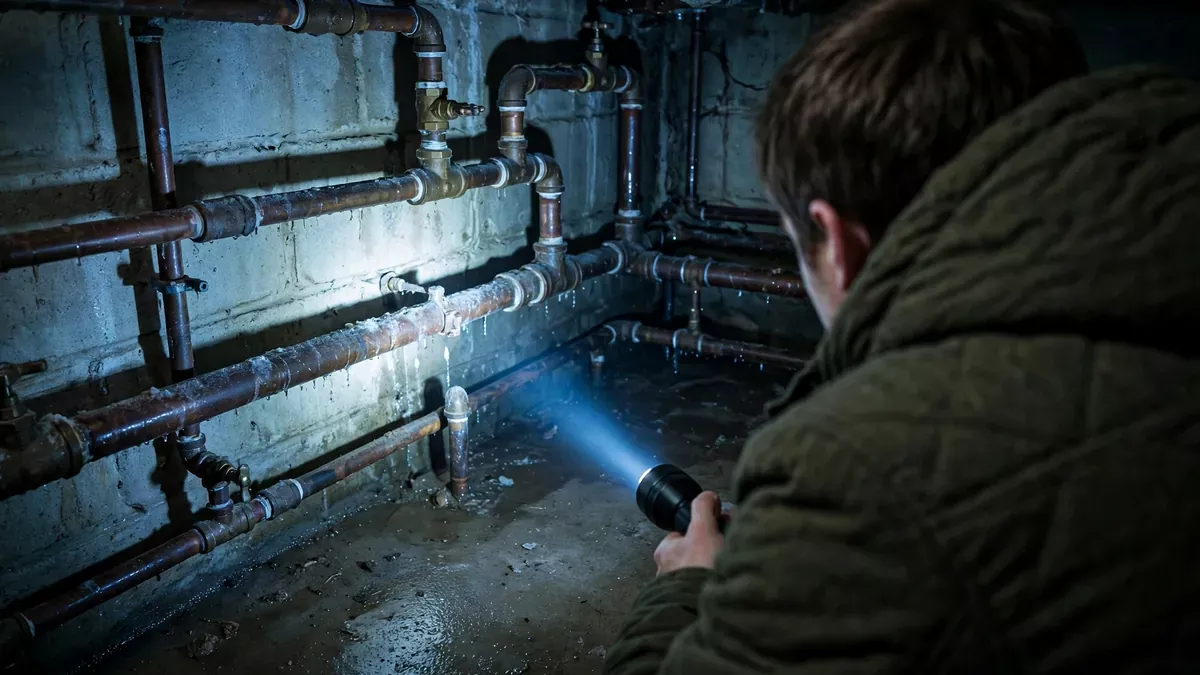
Second, find the frozen section. It is likely in an exterior wall, a crawl space, an attic, or a garage. Look for a section of pipe that is frosted, or that feels colder than the rest. If you cannot find it, the frozen section may be inside a wall, in which case you should call a plumber.
Third, thaw the pipe. Use a hair dryer, a heating pad, a space heater, or towels soaked in hot water. Start from the faucet end and work toward the frozen section, so that the melting water can escape. Do not use an open flame, such as a blowtorch or a propane heater. The fire risk is severe, and the intense heat can damage the pipe.
Fourth, check for leaks. As the ice melts, water will flow through the pipe. If the pipe has cracked, water will leak. If you see a leak, shut off the water at the main valve and call a plumber.
If you cannot find the frozen section, or if you cannot thaw it, or if the pipe has burst, call a plumber. Do not wait. The longer a pipe is frozen, the more likely it is to burst.
What to do if a pipe bursts
A burst pipe is an emergency. The priority is to stop the water.
Shut off the main water valve immediately. This stops the flow of water into the house. The valve is usually near the water meter or where the water line enters the house. Turn it clockwise to close it. If you cannot find the valve, or if it is stuck, call your water utility’s emergency line.
Turn off the electricity if water is near electrical outlets, appliances, or the electrical panel. Water and electricity are a dangerous combination. Do not wade into standing water if there is any risk of electrical contact.
Call a plumber. A burst pipe needs professional repair. The plumber will cut out the damaged section and replace it. If the burst is inside a wall, the wall will need to be opened, which adds to the repair cost.
Document the damage. Take photographs of the burst pipe, the water damage, and any damaged belongings. Contact your homeowners insurance company as soon as possible. Most policies cover sudden and accidental water damage from a burst pipe, but they may not cover damage caused by neglect, such as leaving the heat off in winter. The documentation will support your claim.
Start drying. Water damage gets worse with time. Mold can begin growing within 24 to 48 hours. Remove standing water with a wet vacuum or mops. Open windows if the weather permits. Use fans and dehumidifiers to dry the affected area. Remove wet carpet, padding, and drywall if necessary. A professional water damage restoration company can help with extensive damage.
Frequently asked questions
At what temperature do pipes freeze?
Pipes can freeze when the temperature drops below 20 degrees Fahrenheit, especially if the cold lasts for more than a day. Poorly insulated pipes, or pipes in unheated spaces, can freeze at higher temperatures. Wind chill does not affect pipes directly, because pipes do not feel wind chill, but wind can drive cold air into gaps and cracks, cooling pipes faster.
Does letting the faucet drip really help?
Yes. The drip provides an escape route for pressurized water, preventing the pressure buildup that causes bursts. The moving water is also less likely to freeze than still water. A slow drip, about one drop per second, is sufficient. Let both the hot and cold taps drip, because both pipes can freeze.
Are PEX pipes immune to freezing?
No. PEX, cross-linked polyethylene, is more flexible than copper or steel, and it can expand slightly when water freezes inside it, which makes it more resistant to bursting. But PEX can still burst under extreme pressure, and the fittings, which are usually metal, can fail. PEX is more forgiving than copper, but it is not immune.
Should I insulate pipes in a heated basement?
If the basement is heated and stays above freezing, the pipes are unlikely to freeze. But if the basement is unheated, or if it has exterior walls with air leaks, insulation is a good idea. The cost is low, and the protection is significant.
Will my insurance cover a burst pipe?
Most homeowners insurance policies cover sudden and accidental water damage from a burst pipe, including the cost of repairing the pipe and the water damage. However, they may not cover damage caused by neglect, such as failing to maintain heat in the house during winter, or failing to repair a known leak. Check your policy, and ask your insurer if you are unsure.
Sources and further reading
- US Department of Energy: energy.gov: winterizing your home, insulating pipes, and preventing frozen pipes.
- American Red Cross: redcross.org: how to prevent and thaw frozen pipes, and what to do in a winter emergency.
- Ready.gov: ready.gov: winter storm preparedness, including protecting your home from freezing pipes.
For more on how the systems in your house work, see how your home actually works, and for why the house feels cold even when the thermostat is satisfied, why your house is cold at 70 degrees. The cost of heating is covered in why your heating bill is so high, and our Home & Real Estate section covers more of it.
This article is for general educational and informational purposes only and is not financial, legal, insurance, tax, or medical advice. Always consult a qualified professional regarding your specific situation.