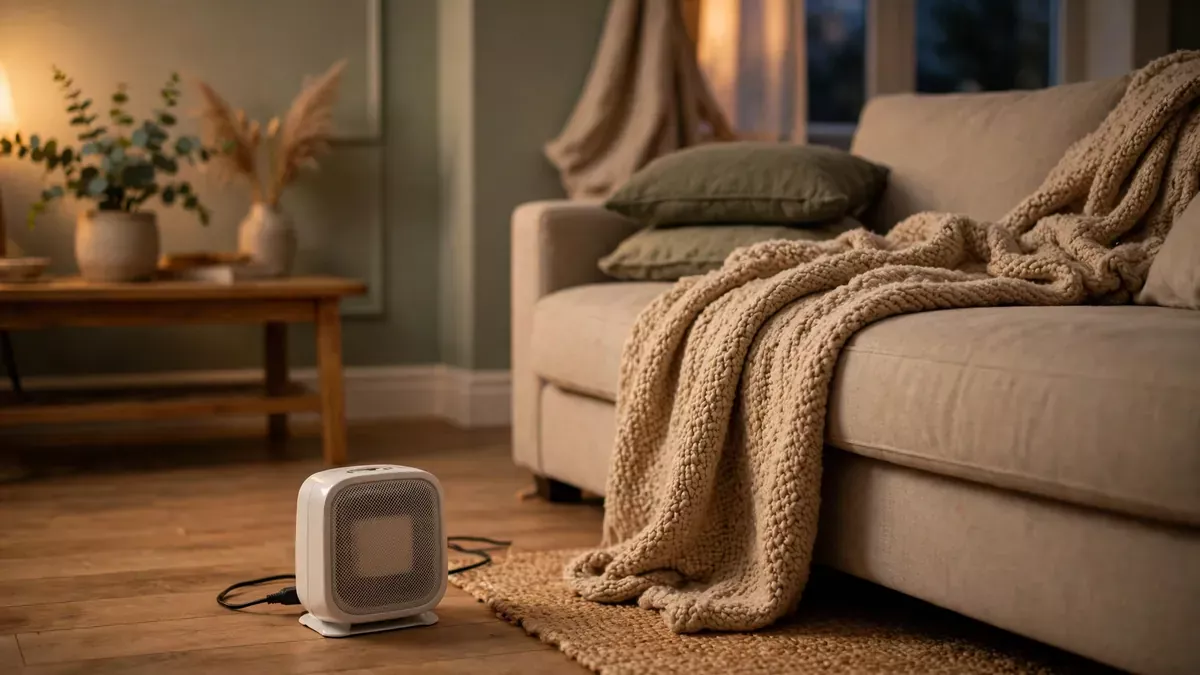
The room is cold. The central heat is running, but the bedroom at the end of the hall is still chilly. You plug in a space heater, and within minutes, the room is warm. It feels like a solution. But is it saving you money, or is it quietly adding to your electric bill?
The short answer is this: a space heater can save money, but only if you use it to heat one room while turning down the central heat for the rest of the house. If you run a space heater in addition to your central heat, at the same thermostat setting, it only adds cost. The savings come from zone heating, heating the rooms you use and letting the rest of the house cool down, not from the space heater itself.
Key Takeaways
- Space heaters use electric resistance heat, which is expensive per unit of heat compared to gas.
- They save money only when they let you turn down the central thermostat, heating one room instead of the whole house.
- A typical 1,500-watt space heater uses about 1.5 kilowatt-hours per hour. At average US electricity prices, that is roughly 25 cents per hour.
- All electric space heaters are about equally efficient at converting electricity to heat. The differences are in how they distribute heat, not in efficiency.
- Space heaters are a leading cause of home heating fires. Safety rules are not optional.
- A heated blanket uses far less electricity than a space heater and is often the better choice for staying warm while sitting still.
Table of Contents
The math: what a space heater costs to run
A space heater’s running cost is easy to calculate, because it uses a known amount of electricity.
Most portable space heaters are rated at 1,500 watts, which is the maximum that a standard household circuit can safely handle. A 1,500-watt heater running for one hour uses 1.5 kilowatt-hours of electricity. The cost depends on your electricity rate.
The average US residential electricity price is around 16 to 17 cents per kilowatt-hour, according to the US Energy Information Administration, though rates vary widely by state and by utility. At 17 cents, a 1,500-watt heater costs about 25 cents per hour to run. If you run it for 8 hours a day, that is about $2 per day, or about $60 per month. If you run it for 16 hours a day, the cost doubles to about $120 per month.
Smaller heaters use less. A 750-watt heater costs about half as much to run, roughly 13 cents per hour at the same rate. A 1,000-watt heater falls in between. The wattage is printed on the heater’s label, and it is the main determinant of the running cost.
The comparison that matters is not the space heater’s cost alone, but the space heater’s cost versus the cost of the central heat it replaces. If turning down the central thermostat by 5 or 10 degrees saves more on your gas or oil bill than the space heater adds to your electric bill, you come out ahead. If it does not, you lose money.
Zone heating: the only way it saves money
The principle behind saving money with a space heater is zone heating: heat the space you are using, and let the rest of the house cool down.
A central heating system heats the entire house to the thermostat setting, whether you are using every room or not. If you spend the evening in the living room, the central system is also heating the bedrooms, the guest room, the dining room, and the hallway, all of which are empty. That is wasted heat.
A space heater lets you heat only the living room. You turn the central thermostat down to 60 or 62 degrees, and you run the space heater in the room you are using. The rest of the house cools down, the central system runs less, and the savings on the central heating bill can exceed the cost of running the space heater.
The savings are largest when the temperature difference is large and the space heater runs for a limited time. If you turn the thermostat down by 10 degrees for 8 hours, and you run one space heater in one room for those 8 hours, the math often works in your favor. If you turn the thermostat down by only 2 degrees, or if you run three space heaters in three rooms, the math does not work.
Zone heating works best in mild to moderate cold, when the central system does not need to work hard to maintain the lower temperature. In very cold weather, the central system may need to run frequently even at the lower setting, and the savings shrink.
When a space heater costs more
A space heater costs more, not less, in several common situations.
If you run it in addition to central heat, without turning the thermostat down, it adds cost and saves nothing. The central system is still heating the whole house, and the space heater is adding heat on top. The room may feel warmer, but you are paying for both.
If you run multiple space heaters, the cost multiplies. Three 1,500-watt heaters running simultaneously use 4.5 kilowatts, which is more than many central heating systems use. At that point, you are paying more to heat with electricity than you would to heat with gas.
If you use a space heater to heat a large or open space, it will run continuously without ever warming the space adequately. Space heaters are designed for small, enclosed rooms, typically up to 150 square feet. In a large open-plan living area, a space heater is fighting a losing battle, running at full power and achieving little.
If you use a space heater as a primary heat source for the whole house, the cost will be very high. Electric resistance heat is the most expensive common heating method, per unit of heat. A house heated entirely by space heaters will have an electric bill far higher than a house heated by gas or by a heat pump.
Types of space heaters
All electric space heaters convert electricity to heat with about 100 percent efficiency. The differences between types are in how they distribute heat, how quickly they warm a room, and how safe they are.
Ceramic heaters use a ceramic heating element and a fan to blow warm air into the room. They heat up quickly and are good for warming a room fast. They cool down quickly when turned off. They are compact and portable.
Oil-filled radiators use an electric element to heat oil sealed inside metal fins. The oil retains heat, so the radiator continues to radiate warmth after it is turned off. Oil-filled radiators heat up slowly but provide steady, even warmth. They are quiet, because they have no fan. They are heavier and less portable than ceramic heaters.
Infrared heaters use infrared radiation to heat objects and people directly, rather than heating the air. They are effective for warming a person sitting nearby, even in a large or drafty space. They do not warm the room as a whole, but they warm the person in their path.
Fan-forced heaters use a heating element and a fan, similar to ceramic heaters, but with a wire element instead of ceramic. They are inexpensive and widely available. They heat quickly but can be noisy.
The choice depends on how you will use the heater. For quick warmth in a small room, a ceramic or fan-forced heater works well. For steady warmth over several hours, an oil-filled radiator is a good choice. For warming one person in a large space, an infrared heater is effective.
Safety: the rules that matter
Space heaters are a leading cause of home heating fires. According to the National Fire Protection Association, heating equipment is a leading cause of home fires, and space heaters account for a disproportionate share of the deaths and injuries, because they are often used incorrectly.
The safety rules are simple, and they are not optional.
Keep the heater at least 3 feet away from anything flammable: curtains, bedding, furniture, clothing, paper, and rugs. The 3-foot rule is the most important safety measure. Most space heater fires start because something flammable was too close.
Plug the heater directly into a wall outlet. Never use an extension cord or a power strip. Space heaters draw a lot of current, and an extension cord can overheat and catch fire. If the heater’s cord is damaged, do not use it.
Never leave a space heater unattended. Turn it off when you leave the room, and turn it off when you go to sleep. If you need heat while sleeping, use a heated blanket, which is designed for that purpose, or set the central thermostat to a comfortable sleeping temperature.
Keep the heater on a flat, level surface, away from water. Do not use a space heater in a bathroom unless it is specifically rated for bathroom use. Do not place it where it can be knocked over by a child or a pet.
Look for safety features: a tip-over shutoff, which turns the heater off if it falls over, and an overheat protection shutoff, which turns it off if it gets too hot. These features are standard on most modern heaters, but check before you buy.
Have working smoke alarms and carbon monoxide alarms in your home. Test them monthly. A smoke alarm will not prevent a fire, but it will give you time to escape.
Better alternatives for staying warm
In many cases, there are cheaper and safer ways to stay warm than a space heater.
A heated blanket uses about 100 watts, compared to 1,500 watts for a space heater. It costs about 2 cents per hour to run, versus 25 cents for the space heater. If you are sitting still, reading, watching television, or working at a desk, a heated blanket keeps you warm at a fraction of the cost.
Wearing warmer clothing is free. A sweater, warm socks, and slippers can make a 68-degree room feel comfortable. The cost is zero, and the effect is immediate.
Draft-proofing the room can make a bigger difference than a space heater. If cold air is coming in around a window or a door, sealing the gap with weatherstripping or caulk will warm the room permanently, without any ongoing cost.
A humidifier can make the air feel warmer. Dry winter air feels colder than humid air at the same temperature. Raising the humidity to 30 to 40 percent makes the room feel more comfortable at the same thermostat setting.
If one room is consistently cold, the problem may be the heating system, not the room. A blocked vent, a duct leak, or an unbalanced system can leave one room cold while the rest of the house is warm. Fixing the underlying problem is better than compensating with a space heater.
Frequently asked questions
Is it cheaper to run a space heater or turn up the central heat?
It depends on the size of the house and the number of rooms you need to heat. If you need to warm one small room for a few hours, a space heater is cheaper, provided you turn the central thermostat down. If you need to warm the whole house, or several rooms, the central system is cheaper, because gas or a heat pump produces heat at a lower cost per unit than electric resistance heat.
How much does it cost to run a space heater all day?
A 1,500-watt heater running for 24 hours uses 36 kilowatt-hours. At 17 cents per kilowatt-hour, that is about $6 per day, or about $180 per month. In practice, most heaters cycle on and off with a thermostat, so the actual cost is lower, but running a space heater continuously is expensive.
Are oil-filled radiators cheaper to run than ceramic heaters?
No. All electric space heaters use the same amount of electricity for the same wattage, and they all convert electricity to heat with the same efficiency. An oil-filled radiator and a ceramic heater, both rated at 1,500 watts, cost the same to run. The difference is in how they distribute heat and how long they retain it, not in the running cost.
Can I use a space heater in a bedroom overnight?
It is not recommended. The National Fire Protection Association advises against leaving a space heater running while sleeping, because you cannot monitor it, and a fire can start without you noticing. If the bedroom is cold, use a heated blanket, or set the central thermostat to a comfortable sleeping temperature.
What is the safest type of space heater?
Oil-filled radiators are generally considered the safest, because their surface temperature is lower than that of a ceramic or fan-forced heater, and they have no exposed heating element. However, all space heaters can cause fires if used incorrectly. The safety features, tip-over shutoff and overheat protection, and the 3-foot clearance rule matter more than the type.
Sources and further reading
- US Department of Energy: energy.gov: space heater efficiency, zone heating, and how to reduce heating costs.
- US Consumer Product Safety Commission: cpsc.gov: space heater safety, recalls, and injury prevention.
- National Fire Protection Association: nfpa.org: heating fire safety, space heater risks, and prevention.
For more on how the systems in your house work, see how your home actually works, and for why your heating costs are what they are, why your heating bill is so high. The cold house problem is covered in why your house is cold at 70 degrees, and our Home & Real Estate section covers more of it.
This article is for general educational and informational purposes only and is not financial, legal, insurance, tax, or medical advice. Always consult a qualified professional regarding your specific situation.