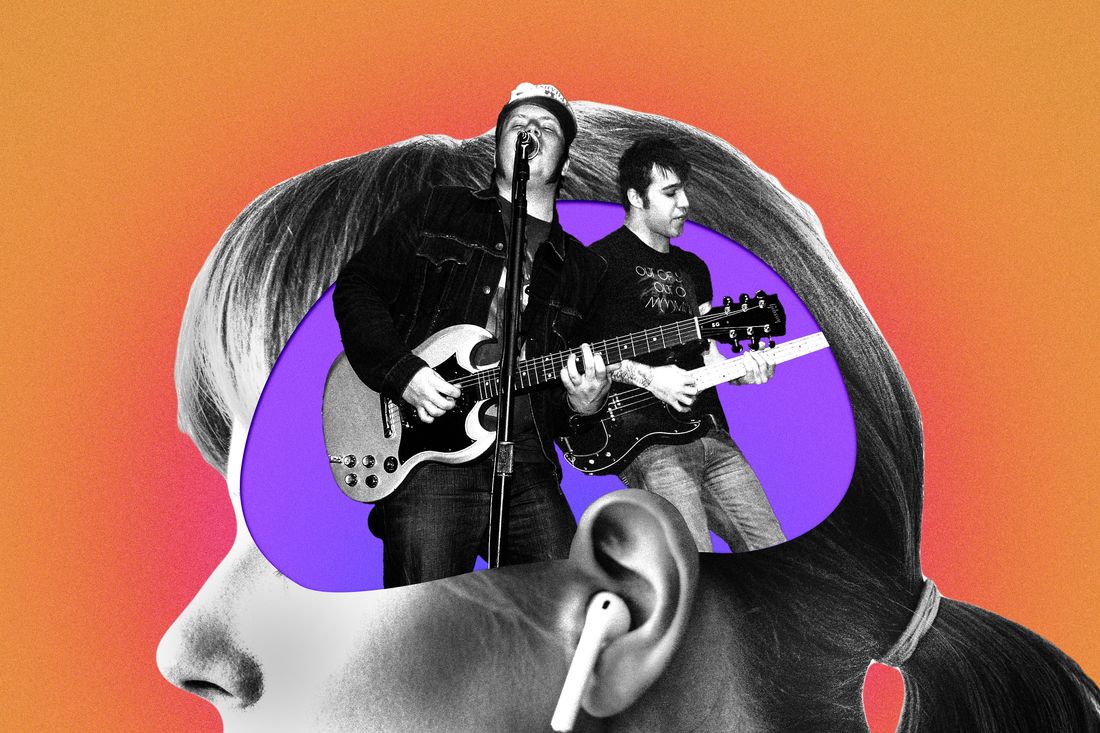
It usually starts innocently.
You hear a song in a shop, watch a short video, listen to a few seconds of music, or hear someone humming a familiar melody. Nothing seems unusual.
Then, several minutes later, you realize the same part of the song is playing in your mind.
You didn’t choose it.
You aren’t listening to the song.
And yet there it is.
Over and over.
The chorus repeats. Then it repeats again. Sometimes it’s only a few seconds of the song, and sometimes you seem to know exactly which part is coming next.
This experience is commonly called an earworm, although psychologists generally refer to it as involuntary musical imagery, or INMI. It describes the experience of music appearing in your mind without deliberately trying to remember or imagine it. Research reviews suggest that it is an extremely common form of spontaneous mental activity. (PubMed Central (PMC))
But why does it happen?
Why can one song become impossible to get out of your head while hundreds of other songs disappear from your memory almost immediately?
The answer involves memory, attention, repetition, familiarity, and the peculiar way the brain represents music.
Your Brain Doesn’t Need the Song to Keep Playing
The first thing to understand about an earworm is that you aren’t actually hearing the song through your ears.
The music is being mentally represented.
Researchers distinguish involuntary musical imagery from musical hallucinations. With an ordinary earworm, you recognize that the music is occurring in your mind rather than coming from an external source. Musical hallucinations are a different phenomenon in which people can experience music as though it is actually being heard. (PubMed Central (PMC))
An earworm is therefore closer to remembering a melody than actually hearing one.
You might mentally replay:
- the chorus of a song
- a short instrumental phrase
- a particular lyric
- a melody from an advertisement
- a few seconds of a song intro
- even a tune you haven’t deliberately thought about for years
And because music contains rhythm, pitch, repetition, and predictable sequences, the brain can reconstruct it without the original sound being present.
Why Does the Same Part Keep Repeating?
One of the defining characteristics of an earworm is repetition.
You don’t necessarily replay the entire song from beginning to end.
Instead, a short fragment can loop repeatedly.
Researchers studying involuntary musical imagery have found that earworms are often short, repetitive sections of music. They can occur after hearing music, recalling it, or encountering something associated with it. (PubMed Central (PMC))
This repetition may have something to do with how musical sequences are represented in memory.
Once your brain has activated a particular sequence, the next part of the melody is highly predictable. The ending of one musical phrase can therefore make the beginning of the same phrase especially accessible again.
It’s almost like a mental loop with no automatic “stop” command.
Imagine saying:
“One, two, three, one, two, three…”
Once the sequence has become established, your brain can continue it without much effort.
Music can work in a similar way.
Repetition Makes Music Easier to Remember
There is an obvious reason that songs are repeated so frequently.
Artists repeat choruses.
Advertisers repeat jingles.
Streaming platforms recommend the same tracks.
You might hear the same song dozens of times without consciously trying to memorize it.
Repeated exposure can strengthen memory for a piece of music, increasing the likelihood that parts of it will later come to mind spontaneously.
A study specifically examining the development of earworms found that repeated exposure to music can contribute to the formation of involuntary musical imagery. (PubMed Central (PMC))
This helps explain why songs you’ve heard many times can suddenly appear in your thoughts.
Your brain has already done the difficult work of learning the sequence.
It doesn’t need the song to be playing again.
The representation is already there.
Why Are Some Songs More “Catchy” Than Others?
Not every song is equally likely to become an earworm.
Researchers have investigated the musical characteristics associated with songs that frequently become stuck in people’s heads. Evidence suggests that certain melodic features can increase the likelihood of involuntary musical imagery, including particular patterns involving pitch and rhythm. (PubMed Central (PMC))
Catchy songs often have another important characteristic:
predictability.
You can often anticipate what comes next.
A melody may rise in a distinctive way and then return to a familiar note. A chorus might contain a repeated rhythmic pattern. A short phrase may have an unusually recognizable shape.
These features make the song easier to mentally reproduce.
This doesn’t mean that there is one universal formula for an earworm.
People have different musical preferences, experiences, and memories. A song that becomes stuck in one person’s head may be completely forgettable to someone else.
Familiarity Makes a Difference
Imagine hearing a completely unfamiliar song in a language you don’t understand.
You might enjoy it.
But you may not remember the melody very well afterward.
Now imagine hearing the chorus of your favorite song.
You may be able to mentally reproduce it almost immediately.
Familiarity gives the brain a stronger memory representation to work with.
Research into involuntary musical imagery has found associations between earworms and recent exposure to music, musical rehearsal, and individual differences in musical experience. (PubMed Central (PMC))
This is one reason musicians can experience musical imagery frequently. They spend more time actively listening to, practicing, and mentally representing musical structures.
But you don’t have to be musically trained to get an earworm.
The phenomenon occurs widely among people with ordinary everyday exposure to music. (PubMed Central (PMC))
Why Does a Song Suddenly Pop Into Your Head?
Sometimes you know exactly what triggered an earworm.
You hear a song and then keep thinking about it.
But other times, the connection seems completely mysterious.
You might wake up with a song in your head.
You might hear one particular phrase during a conversation and suddenly remember a song containing that phrase.
You might walk past a restaurant and remember a song you heard there months ago.
These are examples of how memory can be activated through associations.
The trigger doesn’t necessarily have to be another piece of music.
It could be a person, place, word, emotion, activity, or situation associated with the song.
This makes earworms similar to other forms of involuntary memory.
Something in your environment activates a connected memory without you deliberately searching for it.
Sometimes Your Mood Can Trigger an Earworm
Music and emotion are closely connected.
A particular song may remind you of a relationship, holiday, childhood period, friendship, movie, or important event.
As a result, your emotional state can sometimes influence which music comes to mind.
Research examining involuntary musical imagery has found that earworms can be associated with different emotional experiences. Most everyday episodes are not considered particularly distressing, although longer-lasting or unwanted episodes can become irritating or disruptive. (PubMed Central (PMC))
This can explain why you sometimes get a song in your head that seems perfectly matched to what you’re feeling.
You may not have consciously chosen it.
Your brain may simply have found an association.
Why Do Earworms Often Happen When You’re Bored?
There’s another interesting pattern.
Earworms can appear when you’re doing something that doesn’t require much attention.
You’re taking a shower.
Walking somewhere.
Driving a familiar route.
Cleaning your room.
Waiting for something.
Lying in bed.
During these periods, your attention isn’t necessarily occupied by demanding information.
That leaves more room for spontaneous thoughts.
Research on involuntary musical imagery has linked earworms with low-attention states, and researchers have proposed that spontaneous musical imagery may be related to broader forms of mind wandering and spontaneous cognition. (PubMed Central (PMC))
This is why the song in your head may become particularly noticeable when you’re doing something repetitive.
Your brain has fewer immediate demands competing for attention.
So the internal soundtrack gets louder.
Why Can You Remember a Song You Haven’t Heard in Years?
Music can be remarkably effective at preserving memories.
You might forget someone’s exact birthday.
You might forget what you ate last Tuesday.
But hear a song from your childhood and suddenly an entire period of your life seems to come back.
A melody can act as a powerful retrieval cue.
Research on involuntary musical memories has found that spontaneously recalled music can be associated with autobiographical memories and emotional responses. (PubMed Central (PMC))
This means that when a song gets stuck in your head, it may sometimes bring more than the melody with it.
You might also remember:
- where you used to hear it
- who you were with
- what your life was like at the time
- a particular place
- a relationship
- a holiday
- a movie or television show
- a specific period of your childhood
The song becomes connected to a network of memories.
Could Earworms Actually Help Memory?
This is where the phenomenon becomes even more interesting.
An earworm can be annoying, but involuntary musical imagery may not simply be useless mental noise.
Researchers have investigated whether spontaneously replaying music might contribute to memory consolidation.
In experiments involving novel musical sequences, spontaneous mental replay was associated with later memory for the music. Other research found that involuntary replay could also be related to remembering information that had been associated with the music. (PubMed)
That doesn’t mean every earworm is deliberately helping you learn something.
It also doesn’t mean that having a song stuck in your head is always beneficial.
But it raises an interesting possibility:
The brain may sometimes be reactivating recently encoded information without you consciously deciding to do so.
In that sense, an earworm could be one visible example of how memory continues working in the background.
Why Do Songs Get Stuck in Your Head at Night?
Many people have experienced this.
You’re exhausted.
You turn off the lights.
You close your eyes.
And suddenly the same chorus you’ve heard all day starts playing in your head.
Researchers have specifically studied nighttime earworms.
One study found that people who frequently listened to music reported persistent earworms at night, and these were associated with poorer sleep quality. In a laboratory experiment, participants exposed to music before bed also experienced nighttime involuntary musical imagery. (PubMed Central (PMC))
The researchers suggested that music-related memory processes may continue during periods when you’re trying to sleep.
This could help explain why an earworm can become especially noticeable when everything else becomes quiet.
During the day, your environment is full of competing sounds and tasks.
At night, there is much less external stimulation.
The music in your mind suddenly has the stage to itself.
Why Trying to Force the Song Away May Not Work
There’s an obvious reaction when you get an annoying song stuck in your head:
Stop thinking about it.
Unfortunately, deliberately trying not to think about something can sometimes keep your attention focused on exactly that thing.
You check whether the song is still there.
It is.
You try to push it away.
You notice it again.
You become annoyed.
And now you’re thinking about the song even more.
Research examining people’s responses to earworms found that passive acceptance and enjoyment were among common responses, while seeking out the song or using musical or verbal distraction were also frequently reported approaches for unwanted episodes. (PubMed Central (PMC))
Interestingly, some people find that listening to the complete song helps resolve the loop.
Others find that switching their attention to another activity works better.
There isn’t necessarily one universal solution.
Why Completing the Song Might Help
One possible explanation for why listening to a song can sometimes make an earworm disappear is that you provide the brain with the complete musical sequence.
Instead of repeatedly recalling an incomplete fragment, you hear the sequence through to its natural ending.
However, this isn’t guaranteed to work.
Listening to the song again can also reinforce the memory and potentially make it more accessible afterward.
That’s one reason the best response may depend on the individual situation.
If you’re enjoying the song, there may be no problem at all.
If you’re desperately trying to sleep and the same chorus has been looping for twenty minutes, you might prefer to redirect your attention elsewhere.
Is Having Songs Stuck in Your Head Normal?
For the overwhelming majority of people, yes.
Earworms are considered a common experience in the general population. Research reviews describe involuntary musical imagery as a normal part of everyday cognition rather than something inherently pathological. (PubMed Central (PMC))
The experience becomes more concerning when repetitive musical thoughts are unusually persistent, highly distressing, or interfere significantly with daily life.
Researchers distinguish ordinary earworms from rare clinical experiences such as musical obsessions or musical hallucinations. (PubMed Central (PMC))
Simply having a catchy song stuck in your head does not mean that you have a mental health disorder.
For most people, it’s just another example of the brain generating thoughts without being explicitly asked to.
The Brain Has Its Own Soundtrack
The next time a song suddenly appears in your head, it may be tempting to think of it as an annoying glitch.
But earworms reveal something much more interesting about the human mind.
Your brain can reconstruct music without the music actually being present.
It can replay fragments of songs you heard hours, days, or even years ago.
It can connect melodies to people, places, emotions, and memories.
It can continue processing recently heard music when you’re no longer consciously thinking about it.
And sometimes it can apparently decide that the chorus of the same song needs to play another twenty times.
Scientists are still working out exactly why particular songs become earworms and why some people experience them more often than others. Research points to an interaction between musical structure, familiarity, recent exposure, memory, attention, and individual differences rather than one single cause. (PubMed Central (PMC))
So the next time a song gets stuck in your head, remember that something remarkable is happening.
There is no speaker.
There are no headphones.
The song isn’t playing anywhere in the room.
And yet your brain has managed to press play anyway.